

HVAC guidance to protect commercial humidors: meet ASHRAE 60°F dew point, prevent smoke and moisture migration, commission sensors via BAS.
For frequently accessed rooms or spaces adjacent to smoking areas, use a dedicated, isolated humidor loop or a factory-calibrated humidor system rather than routing humidification through the central air handler. Reserve AHU-integrated humidification for cases where the unit can manage latent load and dew point reliably and sit far enough from the storage zone to let vapor absorb evenly. Either path demands the same non-negotiables: ASHRAE-aligned RH and dew-point limits, correct pressure relationships, redundant calibrated sensors, and a documented commissioning process. Before specifying anything, gather your project brief data and request a site-specific load calculation.
TL;DR:
- Proper humidor design requires dedicated, isolated humidification systems or factory-calibrated units to prevent infiltration issues, especially near smoking areas.
- Dew-point limits of 60°F in mechanically cooled zones impose strict constraints on humidity targets, requiring documentation of exceptions in the design phase.
- Sensor placement, calibration, and BAS integration are critical for reliable control, including independent verification sensors and dew-point calculations.
- Strategies for smoking room ventilation should focus on containment, dedicated exhaust, and pressure zoning rather than relying solely on filtration.
- Commissioning must include thorough airflow, pressure, sensor calibration, and worst-case infiltration testing, with trend data spanning multiple days before final acceptance.
Table of Contents
- Setting humidity, temperature, and dew-point targets
- Choosing and placing humidification, dehumidification, and cooling equipment
- Getting sensors, controls, and BAS integration right
- Preventing smoke and moisture migration between zones
- Commissioning tests, calibration, and ongoing maintenance
- What to gather before requesting a design or quote
- How bespoke and factory-calibrated humidors solve integration challenges
- What most operators get wrong
- Bringing a purpose-built humidor into your space
- Sources
- FAQ
Setting humidity, temperature, and dew-point targets
Cigars hold their character within a narrowband. That target, however, runs into a ceiling set by ASHRAE Standards 62.1 and 62.2, which frame indoor humidity as a moisture and microbial risk rather than a comfort variable and, in some contexts, cap it near 65% RH. The addendum e to Standard 62.1-2022 sets a maximum indoor dew point of 60°F for mechanically cooled spaces, which puts the upper end of preservation-grade humidity in tension with occupant IAQ rules.
This is where design documents earn their keep. When a humidor’s preservation setpoint would push dew point above what the mechanically cooled zone allows, that exception needs to be written into the design basis, not discovered during commissioning.
Design documents should record:
- Outdoor design conditions for the project’s climate zone and season.
- Target zone RH and temperature for the humidor versus adjacent occupied spaces.
- Dew-point calculations at both design and worst-case outdoor conditions.
- Any documented exception to standard IAQ limits, with the engineering rationale attached.
A 60°F indoor dew-point ceiling for mechanically cooled zones means a humidor’s preservation target has to be engineered around, not simply layered on top of, standard comfort cooling.
Choosing and placing humidification, dehumidification, and cooling equipment
Equipment selection comes down to how the space behaves, not how large it is. A duct-integrated humidifier can work well when the AHU serving the zone is sized correctly, the ductwork gives vapor enough distance to absorb before reaching a diffuser, and the load pattern is predictable, meaning steady occupancy and infrequent door cycling. Push moisture in too close to a cold coil or diffuser, and you get condensation instead of even humidification.
Rooms with heavy foot traffic, frequent door openings, or proximity to a smoking lounge behave differently. In those settings, a standalone or factory-calibrated humidor system, whether a dedicated walk-in loop or a self-contained cabinet, holds setpoint far more consistently than a shared AHU ever could, because it is not fighting infiltration from an adjoining space every time a door swings.
Dehumidification deserves its own strategy rather than an afterthought bolted onto cooling. DOE guidance on advanced HVAC humidity control notes that oversizing sensible cooling to chase latent load often leaves humidity uncontrolled anyway, since the compressor short-cycles before it removes enough moisture. Decoupled dehumidification, or pretreating outside air before it enters the space, tends to outperform the brute-force approach of overcooling and reheating.
Sizing has to account for more than square footage:
- Envelope tightness and any vapor-barrier gaps that let ambient moisture migrate in.
- Door frequency and the infiltration load each opening adds.
- Occupant load, display cases, and any adjacent smoking-room exhaust that pulls conditioned air.
Pro Tip: Calculate latent load from your worst realistic door-traffic day, not your average one; a display humidor near a lounge entrance will see far more infiltration than a back-room cigar locker.
Getting sensors, controls, and BAS integration right
A humidor is only as reliable as the sensors reporting on it. Calibrated temperature and RH sensors belong in the storage zone itself, not just on a return-air duct, and should include a dew-point calculation alongside at least one independent verification sensor so a single failed reading never goes unnoticed.
- Place primary RH/temperature sensors at representative storage height, away from doors and diffusers.
- Add a second, independent sensor for cross-verification and drift detection.
- Feed both into a dew-point calculation rather than relying on RH alone.
- Integrate the control loop into the building automation system using BACnet, the standard protocol for HVAC device interoperability, so facility staff can monitor trends centrally.
Control logic should include humidity-aware economizer lockout so free cooling never gets prioritized at the expense of dew point, staged or modulating compressors and fans for finer humidity response, and demand-control ventilation where occupancy varies. For the electronic humidor units this often governs day to day, starting controllers near 66% RH and 66°F gives a stable baseline before fine-tuning to the specific inventory.
- Set alarm thresholds tight enough to catch drift before mold risk, typically a few points outside the target band.
- Route notifications to both facility staff and the service contractor, not one or the other.
- Program a fail-safe mode that shuts down humidification on sensor fault rather than continuing to inject moisture blind, and log every event for later review.
Preventing smoke and moisture migration between zones
Smoke and humidity migrate the same way: through pressure differentials you didn’t plan for. Design the smoking lounge as its own pressure and exhaust zone, with dedicated outdoor exhaust and a makeup-air strategy that replaces what’s pulled out without destabilizing the humidor’s RH next door. EPA indoor air quality guidance is direct on this point: designated smoking rooms carry markedly higher particulate levels, and containment paired with direct exhaust is the recommended control, not filtration alone.
Test pressure relationships under both conditions that matter: doors closed at steady state, and the worst realistic case of simultaneous door traffic during peak hours. Where the layout allows it, a vestibule or an air curtain at the humidor entrance adds a buffer that a single door rarely provides on its own. Our guide to lounge air solutions walks through this pairing in more detail for owners building out a floor plan from scratch.
Filtration and smoke-eaters have a role, but it’s a limited one.
- They reduce odor and visible haze, which matters for guest comfort.
- They do not replace source isolation or direct mechanical exhaust.
- Relying on them alone typically lets particulate and moisture drift toward the humidor over time, especially through any shared return path.
Commissioning tests, calibration, and ongoing maintenance
Commissioning is where a well-designed system either proves itself or reveals what the drawings missed. NIOSH commissioning guidance stresses testing and balancing plus sensor calibration as standard practice, particularly after any change to the ventilation system.
- Verify airflow direction and pressure relationships between the humidor, the lounge, and any smoking area.
- Test worst-case exhaust and makeup-air scenarios, including simultaneous door openings, and document the results.
- Calibrate every RH and temperature sensor against a known reference standard.
- Confirm condensate drainage is clear and humidifier safety interlocks function correctly.
- Trend the system through representative occupied and unoccupied periods before final signoff.
Pro Tip: Ask your commissioning agent for at least 72 hours of trended data spanning one weekend and one weekday before you accept handover; a single afternoon snapshot hides more problems than it reveals.
After handover, maintenance follows a predictable rhythm: quarterly sensor calibration checks, seasonal humidifier service including descaling and safety testing, monthly BAS trend review to catch slow drift, and periodic alarm testing to confirm notifications still reach the right people.
What to gather before requesting a design or quote
Accurate load calculations depend on information only the facility can provide. Collecting it up front saves a design cycle.
- Room dimensions, ceiling height, and construction details, including any vapor-barrier gaps.
- Door size, count, and expected daily traffic schedule.
- Desired inventory volume and shelving or display configuration.
- Available electrical service, condensate or drain routing, and water quality for the humidifier.
- BAS requirements and physical service access for future maintenance.
Each of these reshapes the latent and sensible load math. A room with two high-traffic doors and a display case near an entrance carries a very different infiltration profile than a sealed back-room locker of the same square footage, and that difference shows up directly in equipment size and cost. Our retail humidor layout guide walks through how these inputs translate into a spec-ready plan.
How bespoke and factory-calibrated humidors solve integration challenges
A factory-calibrated, isolated humidor loop sidesteps most of the complexity above by design. When the storage environment doesn’t depend on a shared AHU fighting infiltration or smoking-room exhaust, preservation becomes simpler to guarantee and easier to document for commissioning.
We work with three classes of problem this way. Large-format retail and lounge installations often call for the scale of a display cabinet system, where inventory visibility matters as much as climate stability. Collections needing tight, self-contained RH control without ductwork integration are better served by an electronic humidor with built-in climate control, similar in principle to precision cabinets like the Raching MON800A. Facilities that need secured, individualized storage at volume are better matched to a locker-style system with independent zoning per unit.

Our Dunn’s Bespoke process starts with a consultation covering the inputs above, moves through custom design, and finishes with white-glove installation and commissioning documentation the facility keeps on file.
What most operators get wrong
The single priority in any commercial humidor project is preserving the contents through zoning, redundant sensing, and disciplined commissioning, not through a bigger compressor or a prettier cabinet.
Three mistakes come up often. Operators route humidification through a shared AHU without checking absorption distance, which invites condensation; the fix is a decoupled loop or standalone unit. They treat filtration as a substitute for direct exhaust near smoking areas; the fix is dedicated makeup air and containment. They skip worst-case commissioning tests, then discover drift only after cigars have already suffered; the fix is 72 hours of trended data before signoff.
This week’s practical step: pull your current RH and temperature trend logs and check whether any sensor has drifted more than the setpoint tolerance you specified.
— Belle Dunn
Bringing a purpose-built humidor into your space
Retrofitting an AHU to hit preservation-grade humidity often costs more in engineering time than it saves in equipment. Dunn’s offers a more direct path: purpose-built systems designed around the storage problem from the start.

- The Humidor Supreme® Commercial Display 4000 Humidor Kit suits retail floors that need visible inventory and stable RH in one footprint.
- The Humidor Supreme® Electronic Humidor, 9000 Series Black gives smaller collections integrated electronic control without ductwork.
- The Humidor Supreme® Commercial Cigar Locker Humidor handles secured, individualized storage at scale.
Our consultation covers your site conditions, a walkthrough of Dunn’s Bespoke options, and white-glove installation with commissioning documentation included. Request a site survey through Dunnluxuryselections and get a quote built around your actual room, not a generic spec sheet.
Sources
- Standards 62.1 & 62.2
- Inside story: a guide to indoor air quality | US EPA
- Advanced HVAC humidity control (DOE)
FAQ
What is the 135 rule for cigar humidors?
There is no widely recognized “135 rule” tied to an authoritative standard for cigar storage. Common practice targets 60 to 70% RH and temperatures no higher than 73°F, with ASHRAE guidance setting the upper humidity and dew-point limits that mechanically cooled spaces must respect.
Can I add a humidifier to my HVAC system?
Yes, but only when the AHU has enough absorption distance and can manage the added latent load without condensation risk. For rooms with frequent door traffic or smoking-area adjacency, a dedicated humidor loop or a factory-calibrated system, as DOE guidance suggests, typically holds setpoint more reliably than a shared duct humidifier.
What is the best air ventilation system for a cigar lounge?
The strongest approach separates the smoking lounge from humidor storage with its own pressure zone, dedicated outdoor exhaust, and coordinated makeup air. EPA guidance recommends direct exhaust and containment over filtration alone, since smoking rooms carry far higher particulate levels than adjacent spaces.
Are there HVAC systems that control humidity?
Yes, HVAC systems can control humidity through modulating compressors, staged dehumidification, and decoupled outside-air pretreatment rather than relying on sensible cooling alone. DOE resources note this decoupled approach improves RH stability compared with overcooling and reheat cycles.
How do sensors and BAS integration keep a humidor stable?
Calibrated RH and temperature sensors placed in the actual storage zone, paired with a dew-point calculation and an independent verification sensor, catch drift before it damages inventory. Integrating those sensors into a building automation system over BACnet lets facility staff monitor trends and receive alarms centrally.
Recommended
You May Also Enjoy
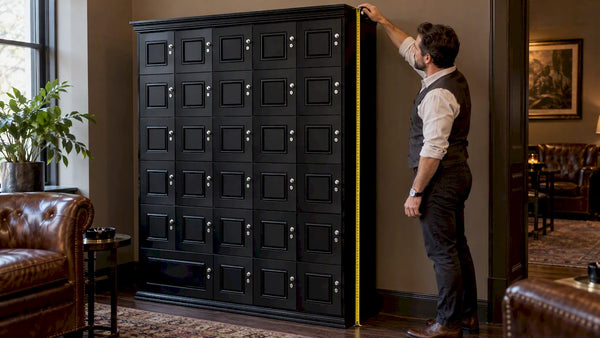
Cigar Locker Dimensions: Sizing Guide for Collectors and Lounges
Cigar locker dimensions explained: compartment sizes, cabinet footprints, capacity math and clearances, so you size a locker bank...
Read Article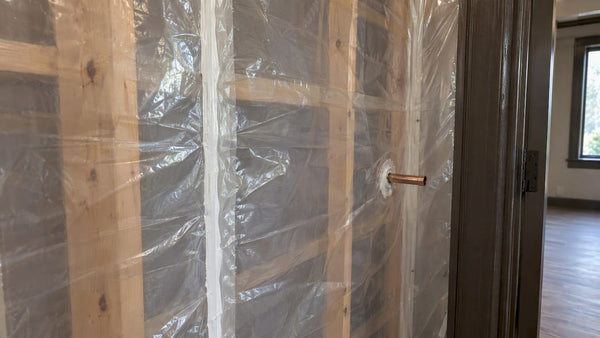
Sealing a Walk-In Humidor: Envelope, Door and Penetrations
How to seal a walk-in humidor properly: vapor barrier placement, door gasket, penetrations and the controlled airflow a...
Read Article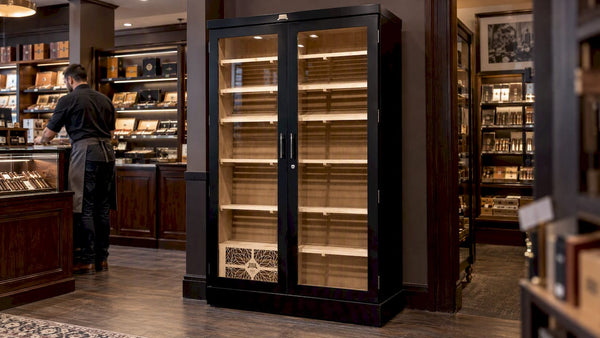
Retail Humidor ROI: How to Measure What a Display Earns
What does a retail or lounge humidor really return? A practical framework for cigar shops, lounges and clubs:...
Read Article