

Protect your cigar collection with expert prevention tips. Learn how to manage temperature and quarantine new arrivals effectively.
Cigar beetle prevention comes down to two moves: keep your storage cool and quarantine every new arrival before it touches your collection. Temperature control is the primary defense against Lasioderma serricorne, the tobacco beetle that turns a $2,000 box of Cuban-seed cigars into confetti. If you take nothing else from this article, take this.
Here’s your immediate checklist:
- Isolate any suspect box in a sealed bag, away from the rest of your collection, the moment you spot pinholes or dust.
- Start a staged-freeze quarantine on anything you plan to save, and on every new purchase before it joins your humidor.
- Check your hygrometer and thermometer right now. If your storage runs warmer than the threshold where eggs hatch, you risk triggering beetle development.
For collectors who want to remove the guesswork entirely, precision humidors from Dunn’s Luxury Selections with active climate control eliminate the environmental triggers that cause outbreaks in the first place.
TL;DR:
- Keeping storage temperature below 70°F, ideally in the 60s, significantly slows the development and reproduction of cigar beetles, especially during warmer months.
- Quarantining all new cigars in a separate humidor or sealed environment before adding them to the collection reduces the risk of introducing active beetles.
- Running a staged-freeze process—24 hours in the refrigerator, 48 to 72 hours at 0°F in the freezer, then back to the fridge—effectively kills all life stages of the beetle.
- Visual inspections every time cigars are brought home or periodically in long-term storage help identify early signs of beetle damage, including pinholes and frass.
- Electronic humidors with active cooling and precise climate control create a stable environment that discourages beetle hatching and reduces infestation recurrence.
Table of Contents
- Cigar Beetle Prevention Starts With Understanding the Life Cycle
- How Do You Inspect Cigars for Beetle Damage?
- What Prevention Methods Actually Stop Cigar Beetles?
- Monitoring: Do Pheromone Traps Actually Work?
- What to Do When You Find Beetles: A Response Plan
- Humidor Features That Reduce Cigar Beetle Risk
- How Dunn’s Luxury Selections Builds Beetle Resistance Into Every Humidor
- Choosing the Right Humidor to Prevent Beetle Problems
- Key Takeaways
- Sources
- FAQ
Cigar Beetle Prevention Starts With Understanding the Life Cycle
The tobacco beetle moves through four stages: egg, larva, pupa, adult. The eggs are microscopic, laid in the crevices of a cigar wrapper or deep in the filler, and you will never see them with the naked eye. That’s the uncomfortable truth behind most infestations. The larvae do the real damage, tunneling through tobacco to feed, leaving the pinholes and powdery frass collectors dread.
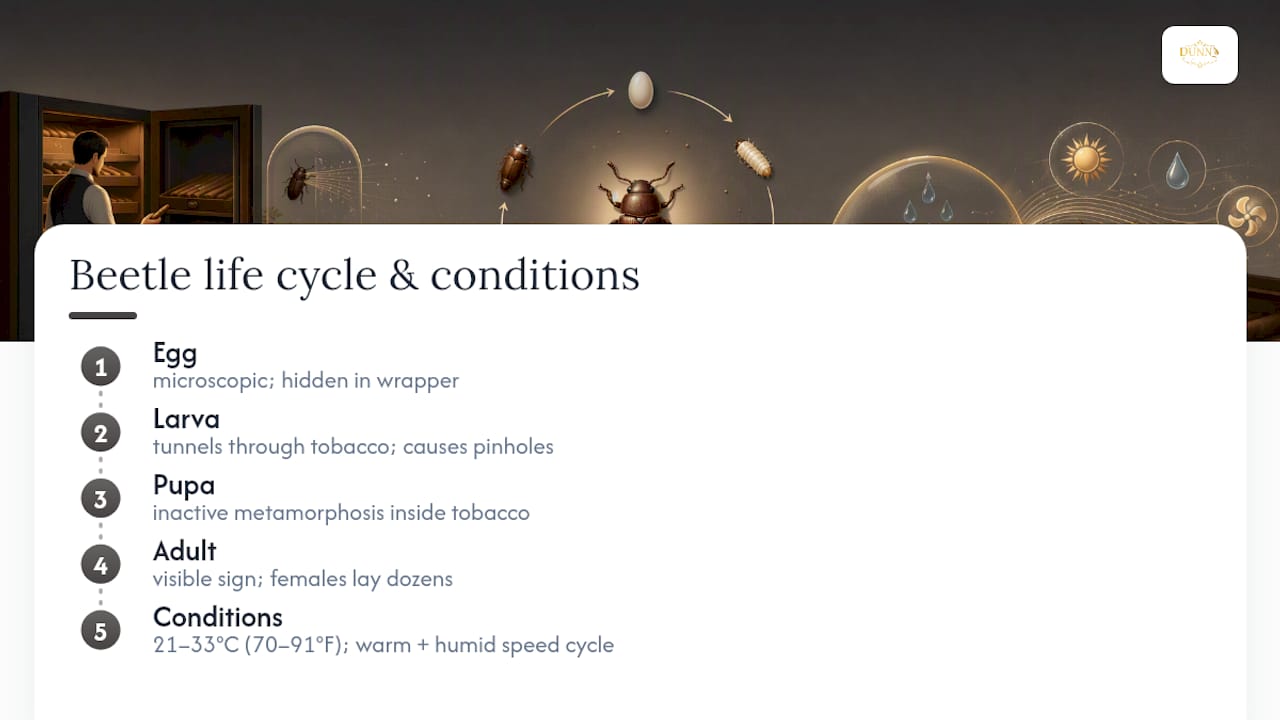
Temperature drives the entire cycle. Life-table research on Lasioderma serricorne found that reproduction rates and generation speed both climb sharply as temperatures rise, with peak fecundity and fastest development occurring between 21°C and 33°C, roughly 70 to 91°F. Push storage into that range, especially the upper end, and a dormant egg population can become a full-blown outbreak within weeks. Humidity acts as a catalyst rather than the trigger itself. Cigars stored at high humidity and warm temperatures create ideal hatching conditions, while cooler, drier conditions slow the cycle without necessarily killing existing eggs.
This is why seeing a single adult beetle should alarm you more than it seems to warrant. Adults are the visible tip of an invisible problem. Females can lay dozens of eggs before you ever spot them crawling across a wrapper, which means one confirmed sighting usually signals a wider infestation across the box, not an isolated incident.
How Do You Inspect Cigars for Beetle Damage?
Detection is a habit, not a one-time event. Run this routine every time you bring cigars home or notice something off in your humidor:
- Scan wrappers under bright, angled light for pinholes roughly the size of a pinhead. These are exit holes larvae leave once they’ve fed.
- Check the box floor and cellophane for fine, sawdust-like frass. That residue is a stronger early signal than the holes themselves.
- Look for small, reddish-brown adults, about 2 to 3 millimeters long, near hinges, seams, or cedar dividers.
- Inspect box corners and paper bands where larvae often bore emergence holes before pupating.
- Bag and isolate anything suspicious immediately, then log the date, box, and cigar count so you can track whether the problem spreads.
What Prevention Methods Actually Stop Cigar Beetles?
The science points to one lever above all others: temperature. The same life-table study on Lasioderma serricorne that measured reproduction across a temperature gradient found gross reproductive rate and population growth accelerated as conditions warmed, while mean generation time shortened considerably at higher temperatures. Translate that into practical terms: storage kept consistently below about 70°F, ideally closer to the mid-to-lower 60s Fahrenheit range, dramatically slows egg viability and larval development compared to the 72 to 75°F range many desktop humidors run at without active cooling.
Cool storage alone won’t necessarily kill an existing infestation, though. Eggs can survive dormant at cooler temperatures for weeks, and larvae are more resilient still. That’s where the staged-freeze protocol comes in, an industry-standard method for reliably killing every life stage:
- Stage one: Move cigars to the refrigerator for 24 hours to acclimate them gradually and reduce moisture shock.
- Stage two: Seal cigars in a heavy freezer bag or vacuum-sealed bag, pressing out excess air, then freeze at 0°F for 48 to 72 hours.
- Stage three: Return the sealed bag to the refrigerator for another 24 hours before bringing cigars back to room temperature.
- Stage four: Leave cigars sealed until they reach ambient temperature fully, preventing condensation from cracking the wrapper.
Pro Tip: Never let cigars touch bare freezer air directly. Condensation forms the instant you open a bag too early, and that moisture is what cracks wrappers, not the cold itself.
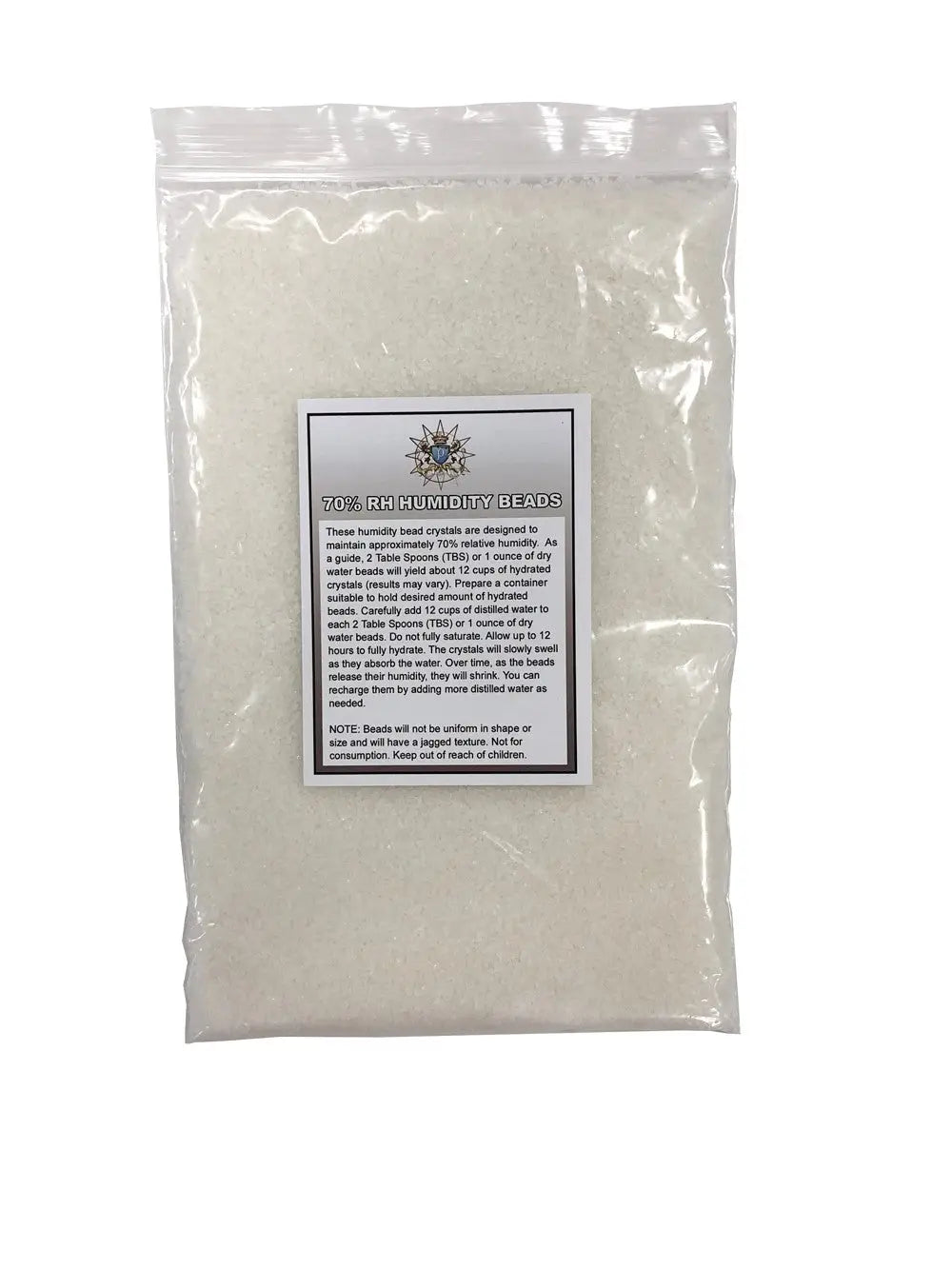
If freezing isn’t an option, whether you’re worried about flavor effects on delicate aging cigars or simply don’t trust your freezer’s consistency, lowering relative humidity to the 62 to 66% range alongside cooler storage reduces hatch rates meaningfully, even though it won’t kill an active infestation outright. This is precisely where precise humidity control separates a serious collection from a vulnerable one. Electronic humidors with active cooling remove the guesswork by holding temperature within a narrow band regardless of what’s happening in the room around them, which matters enormously if you live somewhere summers push ambient temperatures well past 80°F.
Monitoring: Do Pheromone Traps Actually Work?
Pheromone traps have a real role, but it’s a narrower one than most collectors assume. These traps use a synthetic version of the female beetle’s pheromone to lure and capture males, which makes them a monitoring tool rather than a control method. Purdue University’s extension guidance treats traps as useful for locating an infestation source, not for eliminating a population on their own.
Placement matters. Position traps a few feet from doors and vents, and if you’re managing a larger collection or a walk-in, use a grid pattern across the room to help pinpoint which section of storage is affected.
Weekly checks for any box or humidor with prior beetle history or recent new arrivals.
- Monthly checks for a stable, long-term collection with no signs of trouble.
- Visual inspection stays primary. Traps catch males already flying; they say nothing about eggs or larvae already inside a box.
What to Do When You Find Beetles: A Response Plan
Finding beetles doesn’t mean your collection is lost, but how you respond in the first hour matters more than anything you do afterward.
- Isolate everything immediately. Move every box from the affected humidor into sealed bags, and stop handling or rotating cigars until you’ve assessed the damage.
- Run the staged-freeze protocol on anything worth saving, following the same fridge-freezer-fridge sequence described above, with the full 48 to 72 hour freeze window.
- Discard heavily tunneled cigars. If the filler is visibly hollowed or the wrapper has multiple emergence holes, freezing kills the beetles but won’t restore the cigar’s structure or flavor.
- Clean the empty humidor with distilled water only. Never use household disinfectants or chemical cleaners inside a humidor. Cigar Aficionado warns that porous Spanish cedar absorbs residues permanently, ruining flavor for every cigar stored there afterward.
- Replace or recondition cedar sheets and dividers, then let the humidor air out and stabilize for several days before returning any cigars.
Pro Tip: Treat professional fumigation as a last resort. For a private collection, staged freezing combined with a full clean and reconditioning solves the overwhelming majority of cases without the cost or hassle of outside pest control.
Humidor Features That Reduce Cigar Beetle Risk
Not every humidor gives you the same level of protection, and the differences aren’t cosmetic. A dual-sensor digital hygrometer, the kind found in premium electronic units, reads within about 1 to 2% RH accuracy, compared to the 5% or greater drift common in cheap analog dial hygrometers. That precision is the difference between catching a humidity spike early and discovering it after eggs have already hatched.
Collectors storing high-value cigars in warm climates benefit most from active cooling. A passive desktop humidor depends entirely on the room around it, while an insulated cabinet or electronic unit maintains its setpoint independent of the season. Cedar management matters too: rotate and recondition sheets periodically, and skip chemical wipes entirely, distilled water is the only safe cleaner for interior wood. Finally, placement is a bigger factor than most collectors realize. Keep humidors away from windows, HVAC vents, and attic or garage storage, where temperature swings of 15 to 20 degrees in a single day are common.
How Dunn’s Luxury Selections Builds Beetle Resistance Into Every Humidor
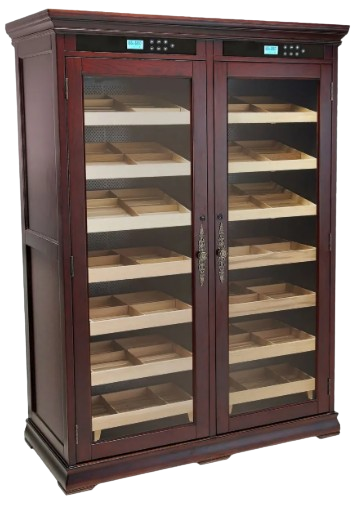
Bespoke construction and precision climate control are not luxuries here, they’re functional defenses. Dunn’s Luxury Selections designs humidors with insulated cabinetry, calibrated sensors, and white-glove installation, addressing the exact conditions that let beetle populations take hold. Site selection during installation, keeping units away from heat sources and direct sunlight, further stabilizes the internal environment before a single cigar goes inside. Our care guides walk collectors through calibration and long-term maintenance so that stability doesn’t degrade after the first year.
A collector’s balance: aging goals versus beetle safety
Irreplaceable cigars deserve caution over ambition. If a box has real age on it and real value, quarantine new arrivals before they ever meet it, and don’t gamble on “it’ll probably be fine.” When a collection grows past a few boxes, investing in custom, climate-stable storage stops being indulgent and starts being the responsible move.
— Belle Dunn
Choosing the Right Humidor to Prevent Beetle Problems
The clearest path to preventing infestations is removing the environmental conditions that cause them, and that starts with the humidor itself. If active cooling and stable temperature are what stop eggs from hatching, then your storage equipment is your first line of defense, not an afterthought.

For collectors managing a growing collection, the Humidor Supreme® 9200 Series Double-Door Electronic Humidor offers active cooling that holds temperature steady regardless of room conditions, precisely the stability that keeps eggs dormant. The compact Humidor Supreme® Electronic Humidor, 9100 brings the same principle to smaller collections. Larger holdings benefit from the Bermuda Cabinet or the Barbatus Cabinet Humidor, both built with insulation that resists the temperature swings warm rooms create. New purchases should never go straight into your main collection. Quarantine them first in a dedicated unit like the Manhattan Travel Humidor, or keep a small, isolated stash in the Duke Premium Desktop Humidor while you inspect and, if needed, freeze them. Collectors who prefer to display prized cigars can do so safely with the Milano Cigar Display, or store smaller quantities in an acrylic humidor jar for short-term, monitored storage. Explore the full electronic humidor collection or request a consultation to find the setup that matches your collection’s size and climate.
Key Takeaways
Cigar beetle prevention works because it removes the temperature and humidity conditions the insect’s entire life cycle depends on, backed by consistent quarantine practices.
| Point | Details |
|---|---|
| Temperature is the primary lever | Keep storage below 70°F, ideally 65 to 68°F, to slow egg viability and larval development. |
| Quarantine every new arrival | Isolate new cigars in a separate humidor before they join your main collection. |
| Staged freezing kills all life stages | Use the fridge, freezer, fridge sequence with 48 to 72 hours at 0°F to eliminate an active infestation. |
| Traps monitor, they don’t eliminate | Use pheromone traps to locate outbreaks, but rely on visual inspection as your main defense. |
| Precision storage reduces recurrence | Electronic humidors from Dunn’s Luxury Selections with active cooling maintain stable conditions that discourage hatching. |
Primary Sources Used in This Article
PMC life-table study on Lasioderma serricorne, Purdue Extension cigarette beetle guidance, Cigar Aficionado on fighting tobacco beetles, MSU Extension cigarette beetle resource, Cigarista staged-freeze guide.
Sources
- Determining the Effect of Temperature on the Growth and Reproduction of Lasioderma serricorne Using Two-Sex Life Table Analysis
- Can You Freeze Cigars? Only to Kill Beetles · Cigarista
- Purdue University extension: cigarette beetle guidance
- Fighting Tobacco Beetles | Cigar Aficionado
- Cigarette beetle - MSU Extension
FAQ
How do you eliminate cigar beetles?
Isolate affected cigars in sealed bags, then run the staged-freeze protocol: 24 hours in the refrigerator, 48 to 72 hours in the freezer at 0°F, and 24 hours back in the refrigerator before returning them to room temperature.
What repels cigarette beetles?
Cool temperatures below 70°F and relative humidity in the 62 to 66% range discourage egg hatching, though nothing fully repels an active beetle population once eggs are present. Precision climate control is the most reliable long-term deterrent.
Can you smoke a cigar with cigar beetles?
Freezing kills the beetles, but a cigar with visible tunneling or hollowed filler has already lost structural integrity and flavor, so discarding heavily damaged cigars is usually the better call.
What smells keep beetles away?
There’s no reliably documented scent that repels cigarette beetles in a home humidor setting. Temperature and humidity control, not fragrance, are the methods backed by research.
How often should I inspect my humidor for beetles?
Check weekly if you’ve had a prior infestation or recently added new cigars, and monthly for a stable, long-term collection with no history of problems.
Recommended
You May Also Enjoy
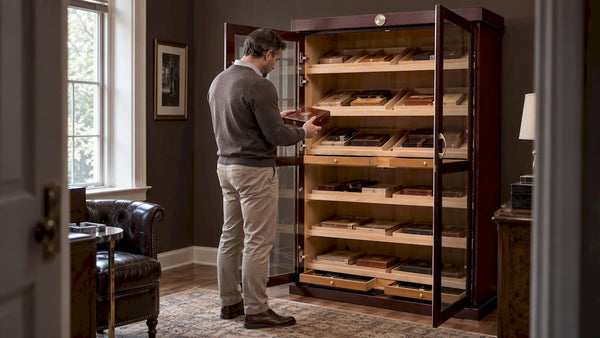
Cigar Collection Insurance: How to Protect Your Humidor
Home policies often cap or exclude cigars. Learn how floaters, agreed value, appraisals and inventories protect a serious...
Read Article
Cigar Locker Dimensions: Sizing Guide for Collectors and Lounges
Cigar locker dimensions explained: compartment sizes, cabinet footprints, capacity math and clearances, so you size a locker bank...
Read Article
Sealing a Walk-In Humidor: Envelope, Door and Penetrations
How to seal a walk-in humidor properly: vapor barrier placement, door gasket, penetrations and the controlled airflow a...
Read Article