

Discover effective tips for traveling with cigars to preserve their quality. Learn how a travel humidor can save your collection!
The single best way to travel with cigars is to move them in a purpose-built, hermetically sealed travel humidor conditioned in advance with two-way humidity packs, then carry that case as controlled, hand-carried luggage rather than checking it. This one decision solves the two failures that ruin more collections in transit than anything else: dry, low-pressure cabin air that pulls oils out of the wrapper, and rough handling that cracks or crushes delicate leaf.
Three things make this approach work:
- Boveda-style two-way packs hold relative humidity steady without a liquid reservoir that can leak or freeze at altitude.
- Calibrated hygrometers let you confirm conditions in real time instead of guessing.
- A commissioned travel humidor, like the bespoke cases Dunnluxuryselections builds for collectors, replaces the flimsy zippered pouch with an engineered, gasketed shell.
Skip this system and you are gambling with cigars that took years to age correctly.
Key Takeaways
Protecting a premium cigar collection in transit requires an airtight travel humidor, correctly sized two-way humidity packs, and hand-carried handling instead of checked luggage.
| Point | Details |
|---|---|
| Choose a sealed case | A gasketed, pressure-rated travel humidor stops cabin air from drying out your cigars mid-flight. |
| Size your Boveda packs | Use one 60-gram pack per roughly 25 cigars plus a spare for any multi-day trip. |
| Target lower travel RH | Aim for 62% to 65% RH in transit instead of your usual home storage level. |
| Check every 48 to 72 hours | A quick feel-test and hygrometer read during stays catches drift before it damages wrappers. |
| Commission a bespoke case | Dunnluxuryselections builds tailored travel humidors with white-glove delivery and calibration for collectors, lounges, and retailers. |
Table of Contents
- What Premium Travel Humidors Actually Do for a Collection
- How Do You Choose the Right Travel Humidor?
- Step-by-Step Packing for a Collector-Grade Move
- Getting Boveda Sizing and Backups Right
- Your Pre-Trip Countdown Checklist
- Storing Cigars Safely at Hotels and Events
- What to Pack: The Compact Travel Checklist
- Why Collectors Commission Bespoke Travel Humidors
- Travel Humidors Built for Collectors, Lounges, and Retailers
- Sources
- FAQ
What Premium Travel Humidors Actually Do for a Collection
A good travel humidor is not a fancier box. It is a small, engineered environment doing four jobs at once: sealing out ambient air, buffering pressure changes, absorbing shock, and holding relative humidity in a tight band regardless of what is happening outside the case. Airline cabins routinely fall below 20% relative humidity at cruising altitude, and a cigar sitting in an unsealed case can lose oils and turn brittle within hours of that exposure, according to Sirae Casa’s guide to private jet travel humidors. That is why the interior material, the seal, and the humidity source all have to work together rather than in isolation.
- Spanish cedar interiors buffer humidity swings and keep tobacco-forward aromas from mingling.
- Gasketed, pressure-rated shells stop the case from equalizing with cabin air the moment the door of an overhead bin closes.
- Two-way humidity packs regulate moisture without free liquid, which matters when a case gets tossed into a cargo hold or a golf cart.
Retailers shipping inventory to a trade show, lounges relocating stock for a private event, and collectors flying a personal humidor aboard a private jet all face the identical engineering problem, just at different scales.
Pro Tip: Never assume a “travel humidor” label means airtight. Check for a continuous rubber gasket around the lid seam; a case that merely snaps shut will leak cabin air within minutes.
Aviation-grade travel cases prioritize hermetic seals, pressure buffering, and cushioned interiors specifically because turbulence and baggage handling are the two most predictable threats a collection faces in transit.
How Do You Choose the Right Travel Humidor?
Match the case to your collection size, trip length, and how much handling risk you are willing to accept. Run through this checklist before you buy:
- Capacity. Count your actual travel needs, not your home humidor’s capacity. A weekend trip rarely justifies more than 15 to 20 sticks.
- Crush protection. Look for a rigid exterior shell, not just a padded interior. Soft-sided cases fail under stacked luggage.
- Seal and gasket quality. Run a finger along the seam. A quality gasket compresses evenly with no gaps.
- Humidity-system compatibility. Confirm the case accepts standard Boveda packs or has a built-in reservoir you can service easily.
- Hygrometer inclusion. A calibrated digital gauge built into the lid beats guessing.
- Airline and event fit. Check dimensions against carry-on limits and event table space if you are staffing a lounge activation.
- Custom and white-glove options. For high-value moves, ask whether delivery, seasoning, and calibration come included.
- Price and service level. A $150 case and a $1,500 commissioned case are not competing for the same job.
Three tiers cover most real-world scenarios:
- Compact 5 to 10 stick hard cases work for a single event, a golf weekend, or a client dinner. Prioritize crush resistance and a tight seal over capacity here.
- 20 to 60 count portable humidors suit collectors traveling for a week or longer, or lounges moving curated stock to a satellite event. This is where seal quality and a reliable hygrometer start mattering more than looks.
- Commissioned aviation-grade cases fit clubs and retailers moving high-value inventory repeatedly. These get built around exact capacity, branding, and handling requirements.
Dunnluxuryselections builds toward all three tiers. The Manhattan Travel Humidor (Black) suits collectors who want a refined, mid-capacity case for regular trips, while the Traveler 15 Humidor by Humidor Supreme® fits the compact end for shorter stays. The tradeoff is always the same: more capacity means more weight and a harder case to carry casually, while a striking exterior finish is worthless if the gasket underneath cannot hold a seal.
Step-by-Step Packing for a Collector-Grade Move
Follow this sequence every time you pack for a trip, not just for long-haul flights.
- Condition the case at least 24 hours before packing so the interior wood reaches a stable humidity level on its own.
- Calibrate the hygrometer using a salt-test kit or a known reference gauge; a drifting reading is worse than no reading at all.
- Insert a fresh two-way humidity pack sized to the case’s capacity, positioned flat against the interior wall rather than wedged among the cigars.
- Leave cellophane on each cigar; it absorbs minor shocks and slows moisture loss during brief seal breaks, a tip echoed in Acosta Cigars’ carry-on packing guide.
- Use foam spacers to keep cigars snug so they cannot slide and tap against the case walls during handling.
- Photograph the packed case before closing it, capturing band details and count for insurance or customs documentation.
- Test the seal by closing the lid and checking for resistance; a proper gasket should require light pressure, not force.
- Carry the case by hand through security and boarding rather than checking it, since checked baggage gets thrown and stacked in ways that crush delicate wrappers.
Pro Tip: If your case uses a vacuum-style seal, expect a slight pressure pop when you open it after landing. That is normal cabin-to-ground equalization, not a failed seal. Recheck the hygrometer an hour after opening before assuming anything went wrong.
Getting Boveda Sizing and Backups Right
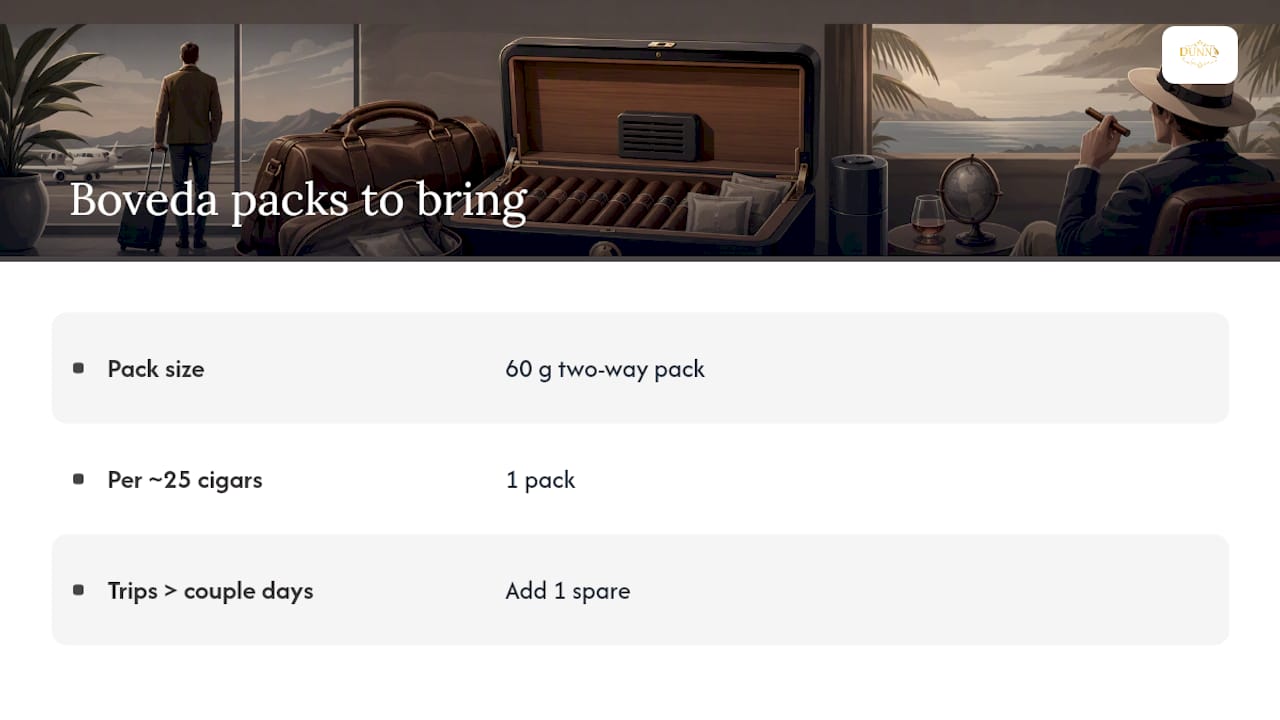
Humidity control during travel comes down to matching pack size to cigar count and knowing when to switch RH percentages. A workable rule of thumb: one 60-gram two-way pack per roughly 25 cigars, plus one spare pack for any trip longer than a couple of days, a ratio recommended in The Cigar Thief’s TSA and travel guide.
- Target 62% to 65% RH for travel microclimates rather than your usual home storage level, since a slightly lower band reduces swelling risk during cabin pressure shifts.
- Choose 65% packs for humid destinations, 69% for balanced climates, and 72% only if you are heading somewhere arid and expect the case to dry out faster than usual.
- Check the hygrometer once daily on multi-day trips; a properly sealed case holds steady for 48 to 72 hours without active humidification, according to Cigar Cuts’ guide to keeping cigars fresh while traveling, but a Boveda pack extends that window considerably.
- Pack a spare pack for every leg of a multi-city trip. Collectors who skip this step often discover a depleted pack only after the wrapper has already started to dry.
Your Pre-Trip Countdown Checklist
Preparation prevents the surprises that ruin a shipment. Work backward from departure.
- Seven days out: Verify the hygrometer’s calibration, inspect the gasket for wear, and order fresh humidity packs if yours are more than a few months old, a timeline recommended by The Cigar Thief.
- 48 to 24 hours out: Condition the case, insert the steady-state Boveda pack, load your inventory, and photograph everything before closing the lid.
- Final two to four hours: Confirm the hygrometer reading one last time, check that the seal closes without forcing it, and set clear handling instructions if someone else is carrying the case.
Skipping the seven-day check is the most common reason collectors discover a dead humidity pack mid-flight instead of on the ground where it can still be replaced.
Storing Cigars Safely at Hotels and Events
Short-term storage away from home comes with its own risk profile. Keep cigars in the travel humidor itself, supplemented with a fresh pack, rather than transferring them into a room safe or minibar fridge, which run too cold and dry for tobacco. A cool, dark, stable spot such as a closet shelf works better than anywhere near a window or air conditioning vent.
- Check the case every 48 to 72 hours during extended stays: a quick feel-test for springiness plus a hygrometer read tells you everything you need to know.
- Replace or supplement the pack the moment the gauge drifts outside your target range.
- Never leave cigars in a car trunk, on a windowsill, or in a bathroom, where humidity swings invite mold rather than prevent dryness.
Pro Tip: At events, assign one staff member to check the display case on a fixed schedule. A single missed humidity check during a two-day trade show can undo weeks of proper conditioning.
What to Pack: The Compact Travel Checklist
Keep this list by your travel case every time you pack:
- Travel humidor, calibrated hygrometer, sized Boveda packs, foam spacers
- Cutter, backup cutter, waterproof matches or a torch lighter
- Documentation or receipts for high-value sticks, plus a photo of the packed case
- Optional for high-value moves: a biometric lock, insurance paperwork, and custom transport tags
Why Collectors Commission Bespoke Travel Humidors
Preservation is an engineering problem before it is a lifestyle choice. A cigar’s oils, wrapper integrity, and burn quality depend on conditions holding steady within a narrow band, and that only happens when the seal, the pressure buffering, and the interior capacity are built around your specific collection rather than a generic template. That is the reasoning behind Dunnluxuryselections’s approach to bespoke travel cases: airtight construction, tailored capacity, and finishes that match a client’s aesthetic as closely as their humidity requirements.
For lounges and retailers, the stakes extend beyond a personal collection. A cracked wrapper at a trade show or a dried-out display case at a member event reflects on the business, not just the cigar. Bespoke transport solutions protect inventory value and the experience a brand promises its clients.
Travel Humidors Built for Collectors, Lounges, and Retailers
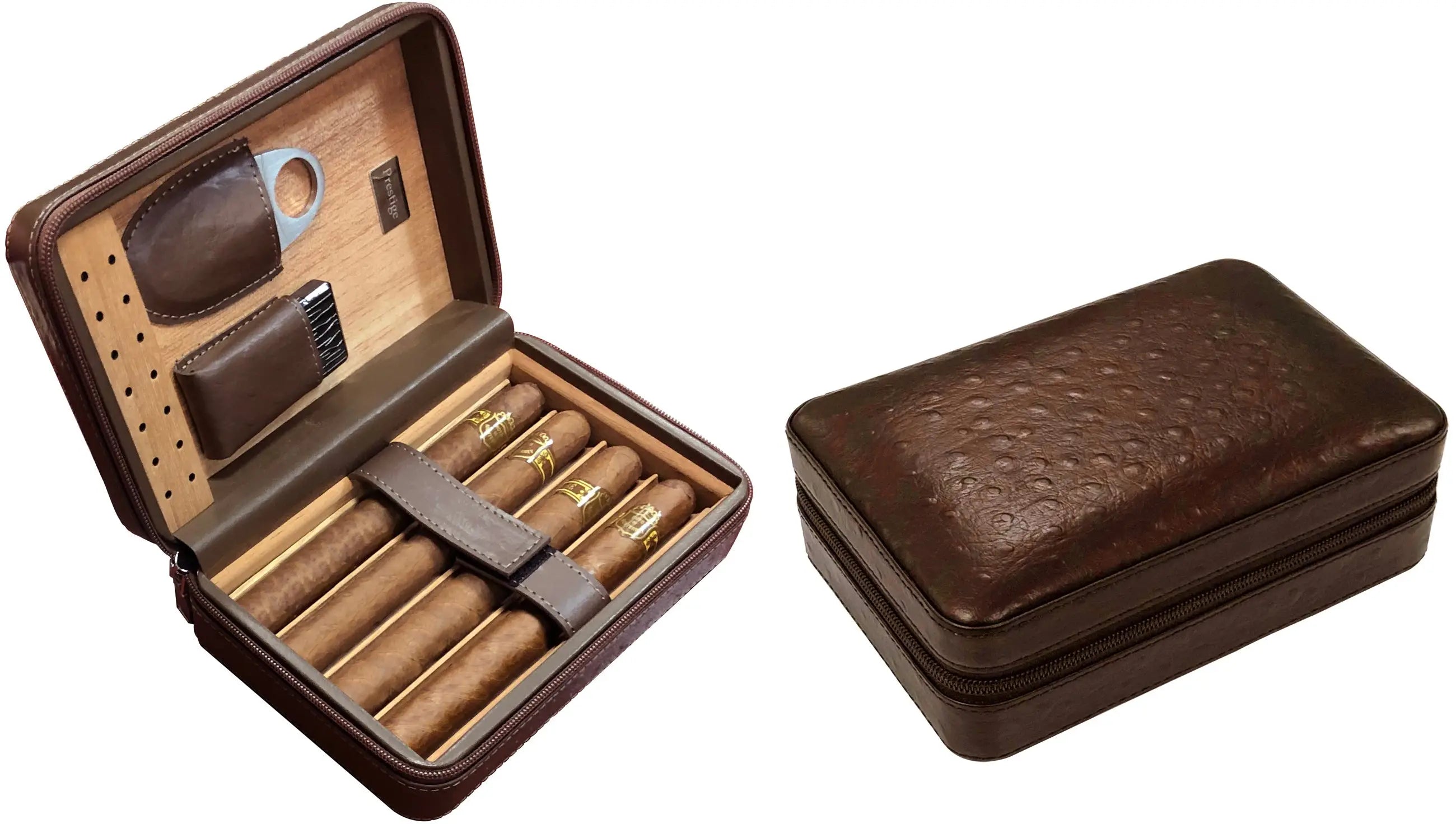
Dunnluxuryselections builds toward exactly the scenarios this guide covers. The Manhattan Travel Humidor (Black) suits collectors who want a refined case for regular trips, while the Manhattan Travel Humidor (Brown) offers a warmer finish for clients matching a lounge or aircraft interior.
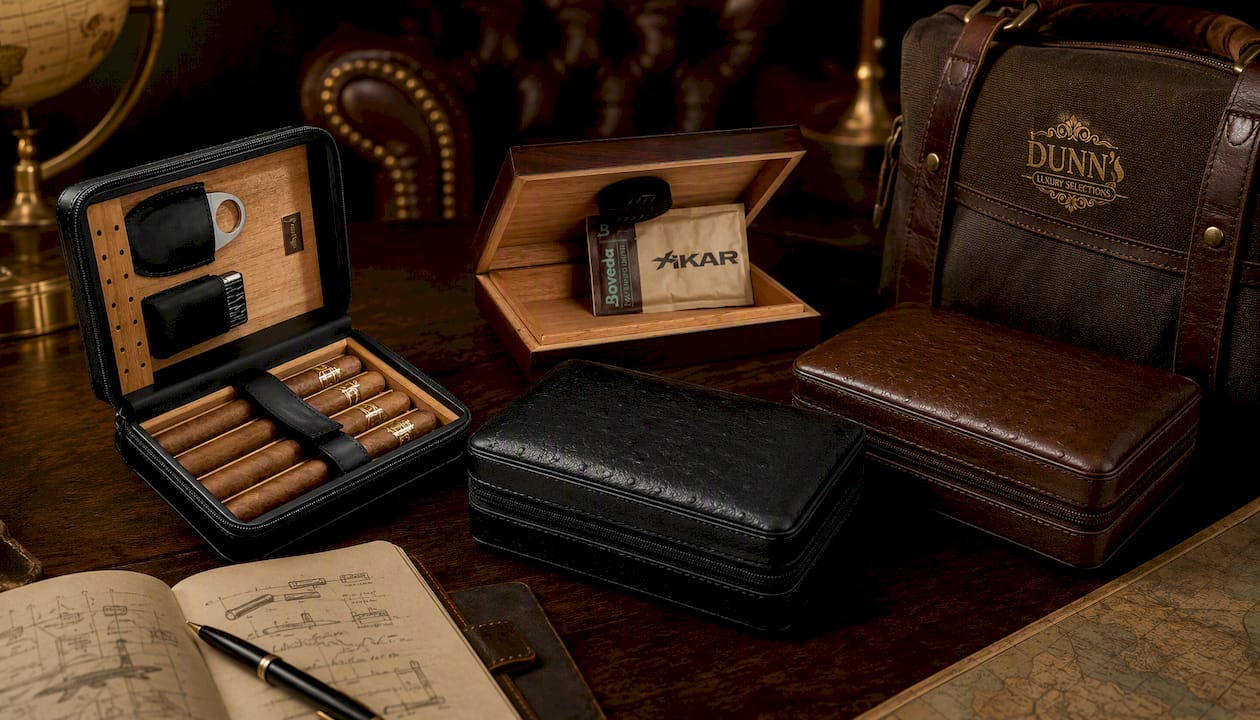
For collectors who need a compact, dependable option, the Traveler 15 Humidor by Humidor Supreme® covers shorter trips without sacrificing seal quality or a proper hygrometer. Beyond these standard offerings, Dunnluxuryselections also commissions fully custom travel cases: white-glove delivery, on-site seasoning, and hygrometer calibration included, so the case arrives ready rather than requiring a week of conditioning on your end. If your lounge, club, or personal collection needs a transport solution engineered around your exact capacity and finish requirements, start a consultation through Dunnluxuryselections’s travel humidor collection.
Sources
- Travel humidor private jet
- Traveling with Cigars TSA Rules & Best Practices | Complete Guide
- How to Keep Cigars Fresh While Traveling: The Ultimate Guide
FAQ
How many Boveda packs should I bring when traveling with cigars?
Bring one 60-gram two-way pack per roughly 25 cigars, plus one spare for trips longer than a couple of days.
What humidity level should a travel humidor maintain?
Should I check my travel humidor as luggage?
No. Carry it by hand, since checked luggage is routinely thrown and stacked in ways that crush delicate wrappers.
How long will a sealed travel humidor stay fresh without a humidity pack?
A well-sealed case typically holds conditions for 48 to 72 hours without active humidification, longer with a two-way pack added.
Does Dunnluxuryselections offer travel-specific humidors?
Yes. Dunnluxuryselections offers the Manhattan Travel Humidor in black and brown finishes and the compact Traveler 15, along with bespoke commissioned cases with white-glove delivery.
When should I start prepping my humidor before a trip?
Begin seven days out by checking hygrometer calibration and seal condition, then condition the case and load it within 24 to 48 hours of departure.
Recommended
You May Also Enjoy
Cigar Locker Dimensions: Sizing Guide for Collectors and Lounges
Cigar locker dimensions explained: compartment sizes, cabinet footprints, capacity math and clearances, so you size a locker bank...
Read Article
Sealing a Walk-In Humidor: Envelope, Door and Penetrations
How to seal a walk-in humidor properly: vapor barrier placement, door gasket, penetrations and the controlled airflow a...
Read Article
Retail Humidor ROI: How to Measure What a Display Earns
What does a retail or lounge humidor really return? A practical framework for cigar shops, lounges and clubs:...
Read Article