

Guide for collectors choosing a climate controlled cigar cabinet. Compare Reagan and Humidor Supreme 9000/9100, sizing advice, RH targets, seasoning, and...
Collectors building a serious long-term aging library should look at the Humidor Supreme 9000 Series Black for its larger footprint and steadier internal climate. If dual-zone precision and near-laboratory tolerances matter to you, the Humidor Supreme 9100 Black is the cabinet built for that job.
TL;DR:
- Active climate-controlled cabinets are essential for aging cigars over several years, as passive humidors cannot maintain stable conditions during seasonal changes.
- The Humidor Supreme 9000 Series Black suits long-term storage and aged collections, while the 9100 Black provides finer humidity control for mixed or varied cigar types.
- Proper sizing involves matching the cabinet capacity to your current collection, using about 20% extra space for future growth, and avoiding oversized units that struggle to stabilize conditions.
- Verify the cabinet’s humidity tolerance is at least ±1–2% RH, and always cross-check built-in sensors with an independent digital hygrometer for accuracy.
- Regular seasoning, gradual loading, and routine maintenance are critical to ensure the cabinet maintains stable conditions and protects long-term cigar quality.
Table of Contents
- What Makes a Climate Controlled Cigar Cabinet Different?
- Reagan, Humidor Supreme 9000, or Humidor Supreme 9100: Which Fits Your Collection?
- Why Cabinets Beat Desktop Humidors and Wineadors for Serious Collections
- What to Check Before You Buy a Cigar Humidor Cabinet
- How the Technical Features Actually Work
- Seasoning Your Cabinet and Keeping It Stable
- What Cabinet Humidors Actually Cost
- Belle Dunn on Testing and Trusting a Cabinet
- What RH Range Should Your Cabinet Actually Hold?
- What Collectors Get Wrong Most Often
- Get the Right Cabinet, Sized and Installed Properly
- Sources
- FAQ
What Makes a Climate Controlled Cigar Cabinet Different?
A climate controlled cigar cabinet is an actively managed storage unit that uses electric humidification and, in most cases, active temperature regulation to hold relative humidity and heat within a tight, programmable band. That distinguishes it from a passive desktop humidor, which depends on a gel jar or foam humidifier reacting to whatever the room throws at it, and from a converted wine cooler, or “wineador,” which controls temperature well but was never engineered for humidity at all.
The category exists because tobacco is organic material in a constant conversation with its environment. Get that conversation wrong and you either dry out a $30 stick into kindling or invite mold and tobacco beetles into a collection worth thousands. Get it right, consistently, and you’re doing something closer to what a wine cellar does for a vintage Bordeaux: creating conditions stable enough that the cigar can actually improve with age rather than simply survive.
The rest of this guide walks through the specific cabinets worth your money, the technical thresholds that separate a real climate system from a marketing label, and the setup habits that determine whether your investment performs the way the spec sheet promises.
Reagan, Humidor Supreme 9000, or Humidor Supreme 9100: Which Fits Your Collection?
These three models cover the range most serious collectors actually shop in, and each one answers a different question about how you store and age cigars.
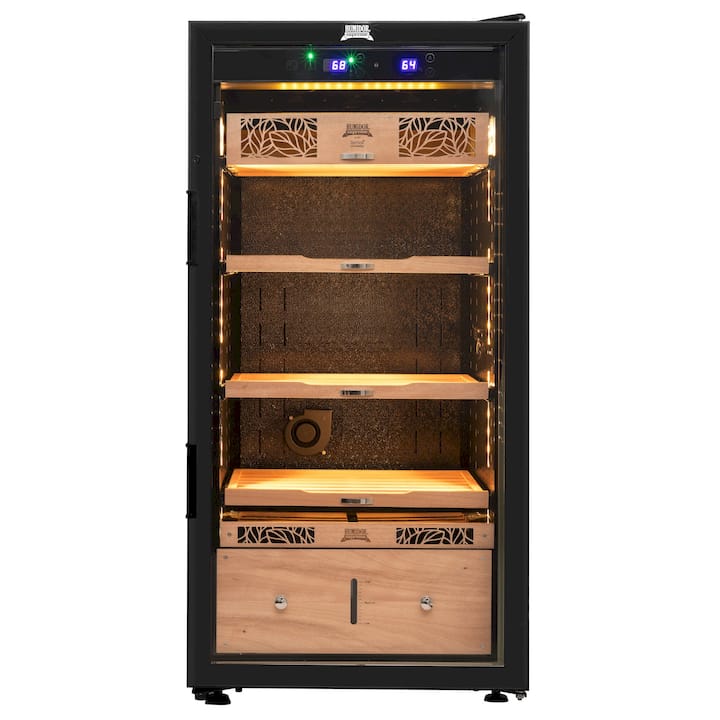
Reagan Electronic Cabinet Humidor. Built for the collector who rotates cigars regularly rather than locking them away for a decade. The Reagan uses electric humidity control to hold RH in a tight band with minimal day-to-day intervention, which matters if you’re the type who opens the cabinet daily and doesn’t want to babysit a hygrometer. Cabinet volume here suits modest collections within a few hundred cigars, boxes and singles combined, without leaving so much dead air that the system struggles to stabilize. If you want a “set it and check it weekly” cabinet rather than a project, the Reagan Electronic Cabinet Humidor is the sensible entry point into active climate control.
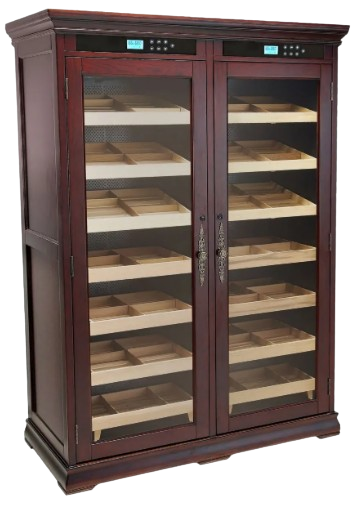
Humidor Supreme 9000 Series Black. This is the model for collectors thinking in years, not weeks. Larger interior capacity means it can house a genuine aging program: boxes segregated by purchase date, cigars you’re deliberately letting mellow for three, five, ten years. The 9000 Series pairs that scale with active electric humidification designed to hold steady through door openings and seasonal shifts in the room outside. Where the Reagan is a daily-use tool, the Humidor Supreme 9000 Series Black behaves more like a small cellar. It rewards collectors who plan to buy by the box and let time do its work.
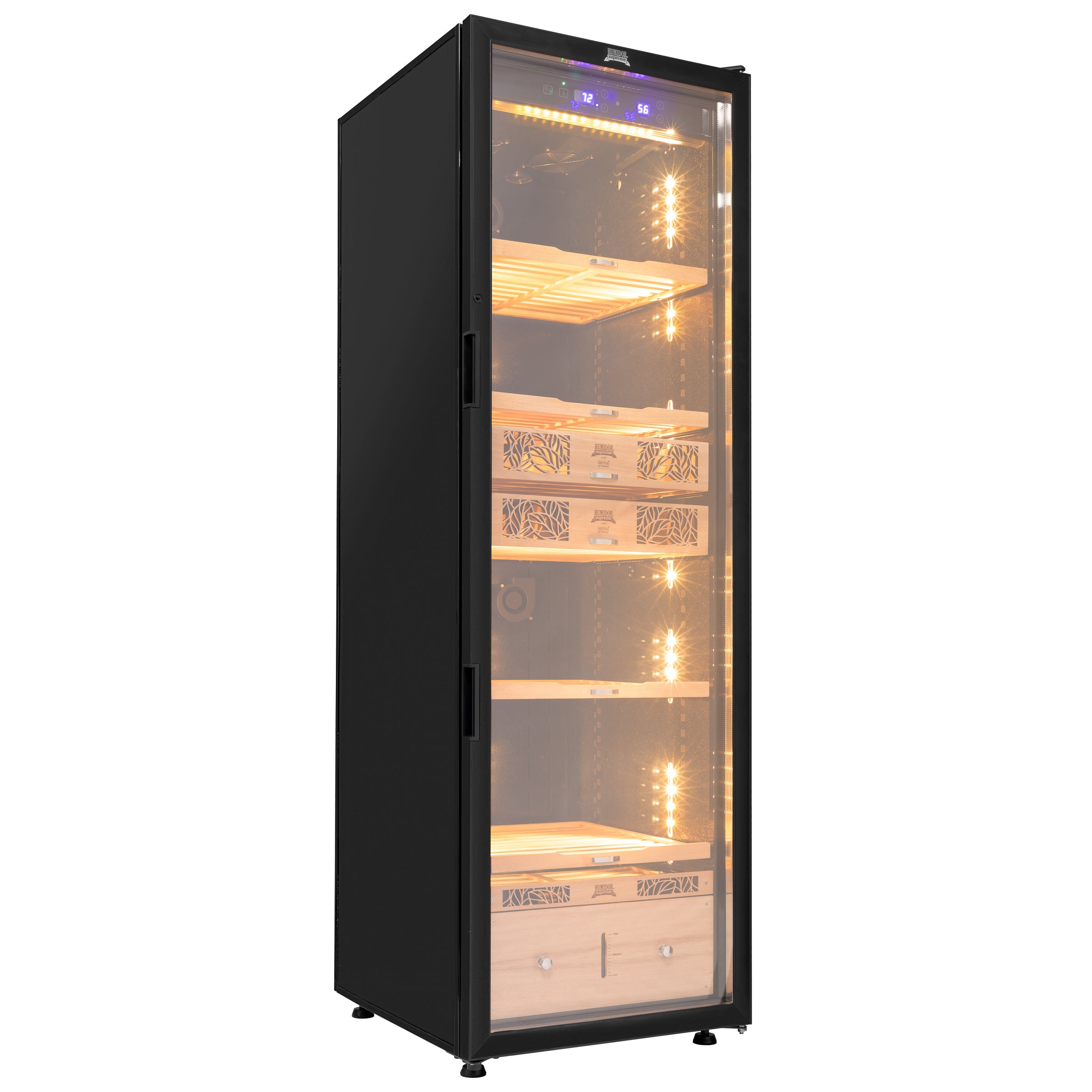
Humidor Supreme 9100 Black. The 9100 targets the collector who wants control down to the decimal point, particularly anyone storing cigars of noticeably different origin or wrapper type side by side. Its feature set leans toward finer humidity precision and monitoring feedback than either the Reagan or the standard 9000, which matters if you’re storing, say, a box of Connecticut-wrapped cigars that prefer a slightly drier environment next to a maduro blend that tolerates more moisture. For collectors who treat their hygrometer readings the way a sommelier treats cellar temperature logs, the Humidor Supreme 9100 Black is built for that level of attention.
A quick way to sort yourself into one of these three:
- You open your cabinet most days and want reliability without complexity: the Reagan.
- You’re building a library meant to age five-plus years and need real volume: the 9000 Series Black.
- You want the tightest possible tolerances, possibly with distinct zones for different cigars: the 9100 Black.
None of these are interchangeable decisions dressed up as three SKUs. They map to three different relationships collectors have with their cigars, and buying the wrong one for your actual habits is the single most common regret in this category.
Why Cabinets Beat Desktop Humidors and Wineadors for Serious Collections
Desktop humidors and wineadors are passive systems wearing an active system’s reputation. A desktop unit relies on a humidification element reacting after humidity has already drifted, which means it’s always playing catch-up rather than holding a line. A cabinet with real electric climate control does the opposite: it monitors and corrects continuously, which is why active units can hit ±1–2% RH precision where a passive box swings within a much wider, less predictable range.
Four situations tell you it’s time to move up: 1. Your collection has crossed a threshold where active storage is justified, often around 100 cigars. Collectors typically hit the point where collection size or insured value justifies active storage at about that level, since a single humidity failure now threatens real money, not a handful of sticks. 2. You’re storing cigars with real per-stick value. A box of aged Cuban-seed puros or a limited-release humidor tin changes the math. Passive systems fail quietly; cabinets fail loudly, with alarms and readouts that let you intervene before damage happens. 3. You intend to age cigars, not just store them. Aging rewards stability far more than it rewards any single “perfect” number, and active systems hold a chosen RH point through weather swings that would send a desktop humidor drifting for days. 4. Your climate is unstable. Homes without whole-house humidity control, or regions with sharp seasonal swings, put more strain on passive humidifiers than they’re built to handle.
The tradeoffs are real and worth naming plainly. Cabinets take up floor space a desktop unit never will. Active cooling and circulation systems produce a faint hum that some collectors notice in a quiet room. And electric components draw power continuously, which is a fair question if you’re storing a cabinet somewhere without easy outlet access. None of these tradeoffs are dealbreakers for a serious collector, but they’re the honest cost of the precision you’re buying.
What to Check Before You Buy a Cigar Humidor Cabinet
Sizing correctly starts with counting boxes and singles separately, then adding roughly 20% of headroom for growth. Buying too much empty volume is the most common and most avoidable mistake in this category. A small cabinet packed near capacity holds humidity more evenly than a large one sitting mostly empty, because wood, cardboard, and the cigars themselves act as a humidity buffer that a cavernous, half-empty interior simply doesn’t provide. If you’re starting a new cabinet with a modest collection, use dividers or filler boxes to shrink the effective air volume until your inventory catches up.
Humidity precision is where marketing language gets loose fastest. A true climate controlled cabinet holds ±1–2% RH. Anything advertised at ±5% or wider is closer to a well-insulated box than an active system, and that gap compounds over months of storage. ±5% tolerance might be acceptable for a casual, fast-rotating collection of everyday cigars you’ll smoke within a season. It is not acceptable for anything you intend to age.
Dual-zone capability matters more than most first-time buyers assume. If you store cigars with meaningfully different humidity preferences, wrapper types that like it drier next to maduros that tolerate more moisture, a single-zone cabinet forces a compromise on both. Require dual-zone control if your collection spans more than one broad style or if you’re storing both daily smokers and long-term age candidates in the same unit.
Before you commit, inspect the build itself:
- Cedar thickness and coverage. Thin veneer over particleboard behaves nothing like solid or properly lined Spanish cedar; the wood should feel substantial, not papery.
- Seal and gasket quality. Run a finger along the door seam; a loose or brittle gasket is where humidity leaks fastest.
- Door fit and swing. A door that doesn’t close flush under its own weight will fight your climate system every single day.
- Shelving layout. Adjustable, well-spaced shelving supports even airflow; fixed shelves crammed too close together create dead zones.
Ask any vendor about monitoring hardware and warranty terms before you buy. A cabinet without a reliable digital hygrometer and temperature readout is asking you to trust it blindly. Confirm what the warranty covers on the electronic components specifically, since that’s the part most likely to need service, and ask what a service call actually involves if the unit is ever out of calibration.
Pro Tip: Buy a separate calibrated digital hygrometer even if your cabinet has a built-in readout. Built-in sensors drift over time, and a $20 cross-check device has saved more than a few collections from a slow, unnoticed humidity slide.
If you’re weighing insulation quality specifically, our guide to cabinet insulation and stable RH breaks down how construction choices translate into real-world humidity holding power.
How the Technical Features Actually Work
Not every feature on a spec sheet earns its place. Here’s what matters and why.
Humidification methods. Ultrasonic humidifiers produce a fine mist and respond quickly to drops in RH, but they can overshoot if poorly calibrated. Evaporative systems are gentler and more forgiving of small swings, though slower to recover after a big door opening. Gel or crystal-based passive backups exist in some cabinets as a failsafe, but they shouldn’t be your primary system in anything marketed as climate controlled.
Cooling and heating types. Thermoelectric (Peltier) cooling is quiet and efficient for modest temperature drops, which suits most home cabinets. Compressor-based cooling handles larger temperature differentials and hotter climates better but runs louder and draws more power. PTC heating elements, used in cabinets that need to raise temperature rather than just lower it, tend to be more precise than simple resistive heaters and hold a steadier line. None of this is trivial: sustained temperatures above roughly 72°F meaningfully raise the risk of tobacco beetle eggs hatching, so a cabinet’s ability to actively cool, not just passively insulate, is a real preservation feature, not a luxury add-on.
Airflow and shelving. Even circulation matters as much as the humidification source itself. Air distribution and door seal quality determine internal consistency more than any single humidifier spec, because a cabinet can hold perfect average humidity while still having a dry top shelf and a damp bottom shelf if airflow is poor.
Ammonia and odor management. Fresh tobacco releases ammonia as it cures further in storage, and better cabinets include ventilation or filtration designed to let that gas escape without letting humidity escape with it. This is a genuine long-term aging feature, not a gimmick, since trapped ammonia can affect flavor development over years of storage.
Monitoring and calibration. Set a habit of checking digital readouts daily for the first two weeks after setup, then weekly once the cabinet stabilizes. Cross-check any built-in hygrometer against an independent digital unit every few months. Sensor drift is slow and easy to miss until a cigar starts feeling wrong in the hand.
Recommended targets differ slightly by purpose: daily smokers do well in the 64–69% RH range, while collectors aging cigars long-term often run slightly drier, around 62–66%, to reduce mold risk while still allowing slow maturation.
Seasoning Your Cabinet and Keeping It Stable
A new cabinet is a dry box until you tell it otherwise, and skipping this step is why some collectors think their new cabinet “doesn’t work” in the first week.
- Wipe every exposed cedar surface with distilled water using a clean, lint-free cloth. Never use tap water; minerals in it leave residue that affects both wood and long-term humidity readings.
- Place a damp sponge, soaked in distilled water and set inside a plastic bag with a few holes cut in it, inside the empty cabinet.
- Run your humidification system per the manufacturer’s instructions and let the cabinet sit closed overnight, undisturbed, before loading anything.
- Check the hygrometer the next morning. If you’re in the target band, you’re ready to load cigars. If not, repeat the sponge step for another day.
Cabinets take noticeably longer than desktop humidors to season and stabilize simply because there’s more air and more wood absorbing moisture before equilibrium sets in. Expect several days, not hours, before a large unit holds steady.
When you load your first cigars, don’t scatter a handful of boxes across a mostly empty cabinet. Fill dead space deliberately with cedar trays, spare boxes, or filler blocks, since a fuller cabinet stabilizes faster and holds steadier than a sparse one. Add cigars gradually over the first two weeks rather than all at once, giving the system time to adjust to each new load.
Once running, keep a simple rhythm: check the hygrometer daily during the first month, then weekly. Refill or top off the humidification element on the schedule the manufacturer specifies, usually every few weeks. Wipe down door seals monthly and inspect them for cracking or compression loss annually.
If you see humidity overshoot, first check for a stuck humidifier or a miscalibrated sensor before assuming the unit is broken. Undershoot usually traces back to a door seal that’s lost its grip or a humidifier reservoir that ran dry. Hotspots near the top of a cabinet often mean airflow is blocked by overpacked shelving. Condensation on interior walls signals the humidification system is overcorrecting, usually fixable by adjusting the target RH down a point or two. And if you ever spot small holes in a wrapper or fine dust near a box, isolate that box immediately, drop the cabinet’s temperature if you can, and inspect every other box before returning anything to storage.
For a full setup walkthrough tailored to specific models, our care guides cover seasoning schedules and maintenance checklists in more depth.
What Cabinet Humidors Actually Cost
Entry-level electric cabinets, built for smaller collections and daily rotation, typically run in the $1,500 to $3,000 range. At this tier you’re paying for reliable active humidification and basic temperature stability, not dual-zone precision or premium cabinetry.
Mid-tier precision cabinets, the category the Humidor Supreme 9000 Series occupies, generally land in the $3,000 to $8,000 range. Here you start seeing tighter RH tolerances, better cedar quality, and monitoring hardware that gives you real visibility into internal conditions rather than a single approximate readout.
Premium and dual-zone units, where the Humidor Supreme 9100 sits, run higher, reflecting the added engineering behind independent climate zones and finer calibration. Custom walk-in solutions, built for collectors and lounges storing thousands of cigars, are priced individually based on square footage, finish, and climate system complexity.
What actually separates these tiers isn’t decoration. It’s tighter tolerances, thicker cedar, better seals, and dependable feedback through quality hygrometers, the unglamorous engineering that determines whether your cigars are actually protected or just handsomely displayed.
- Entry cabinets: reliable humidification, modest capacity, basic monitoring.
- Mid-tier cabinets: active temperature control, better cedar, digital readouts.
- Premium and custom builds: dual-zone precision, finer calibration, bespoke sizing.
Ask about financing and warranty terms before you buy at any tier, since a cabinet’s total cost of ownership includes service calls and part replacement over the years you’ll own it, not just the sticker price.
Belle Dunn on Testing and Trusting a Cabinet
I’ve spent enough time around collectors’ cabinets to know that the specification sheet only tells you what a cabinet is capable of, not whether it will actually protect what’s inside it. That gap gets closed through construction quality and, frankly, honest guidance at the point of purchase.
At Dunn’s Luxury Selections, that means building and offering custom walk-in humidors alongside curated cabinet lines, backed by white-glove delivery and installation guidance rather than a box left on a doorstep. Every cabinet we recommend gets evaluated the way a serious collector would evaluate it: cedar quality checked by hand, seal integrity tested, humidification response verified against an independent hygrometer before it ever reaches a client.
The difference between a cabinet that merely holds a number and one that holds a cigar’s future is almost always in the details nobody photographs: the gasket, the cedar grade, the sensor calibration. That’s where the real curation happens.
If you’re weighing a purchase against a bigger commitment, our walk-in humidor guide and financing consultation walk through what scale actually costs and what it buys you in return.
— Belle Dunn
What RH Range Should Your Cabinet Actually Hold?
Forget the old habit of chasing a single perfect number. The 65% to 72% RH range works for most collections, with 69% frequently cited as the preferred midpoint for cigars you plan to smoke within a year or two.
What matters more than hitting an exact figure is holding whichever point you choose steady. Pick a target inside the acceptable band and configure your cabinet to defend that number, rather than resetting it every time you read a new article recommending a slightly different figure.
If your cabinet supports dual zones, this is exactly the split worth setting up: one zone for what you’ll smoke this season, another for what you’re letting age.
What Collectors Get Wrong Most Often
The costliest mistake I see is buying a cabinet sized for the collection you hope to have in five years instead of the one you have now. An oversized, mostly empty cabinet fights its own climate system constantly, and the collector blames the equipment when the real problem is empty air.
A close second is chasing high humidity numbers because “more humid” sounds safer. It isn’t. Overly wet storage invites mold and accelerates tobacco beetle risk far more than a well-managed mid-60s environment ever will.
The third mistake is treating the built-in hygrometer as gospel and never buying an independent one to check it against. Sensors drift quietly, and by the time a cigar feels wrong in your hand, the damage is already done.
If you take one thing from this: buy for capacity and monitoring, not cosmetic extras. A plain cabinet with accurate sensors and honest RH control will protect your cigars better than a beautifully finished one with a sensor nobody ever double-checked.
Get the Right Cabinet, Sized and Installed Properly
You’ve seen the specs, the price bands, and the mistakes that sink most cabinet purchases. What Dunn’s Luxury Selections does differently is close the gap between picking a model on a page and actually owning a cabinet that performs as promised in your space.
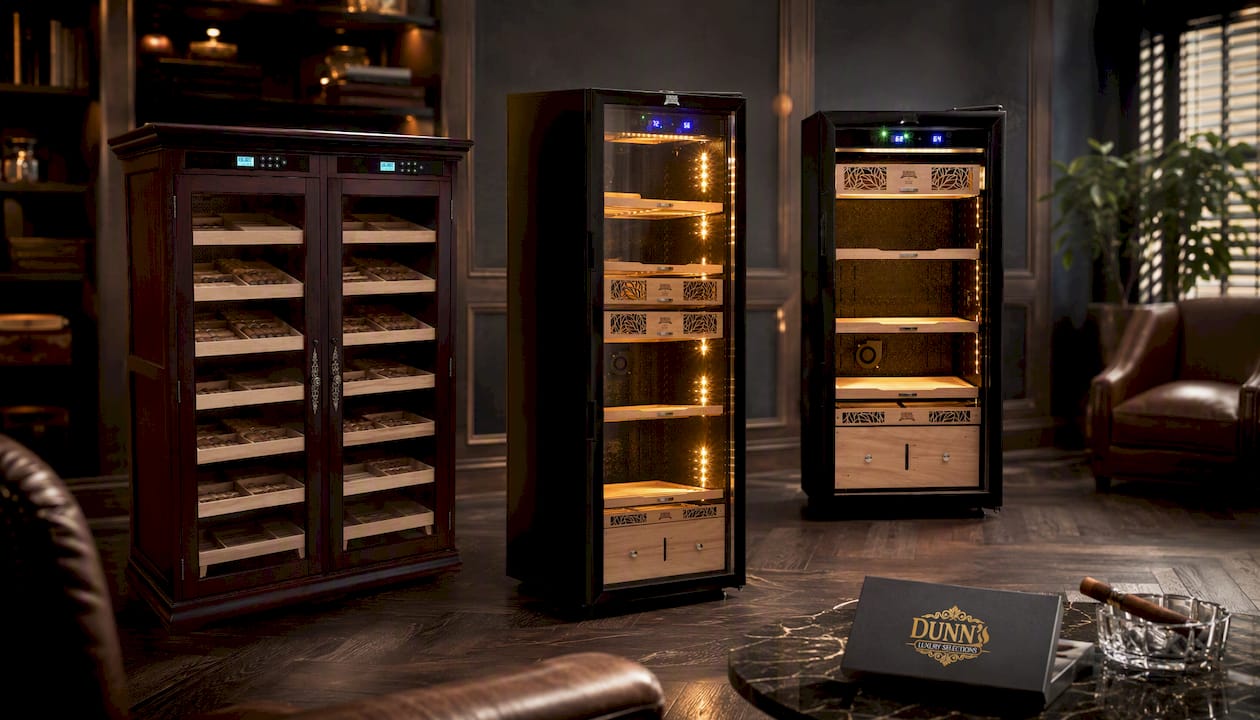
Every model discussed here, the Reagan Electronic Cabinet Humidor for daily rotation, the Humidor Supreme 9000 Series Black for long-term aging libraries, and the Humidor Supreme 9100 Black for dual-zone precision, is available for consultation before you buy, not just after. That matters because sizing and placement questions are easier to solve with a conversation than a return shipment.
If your collection has outgrown typical cabinets on the market, custom walk-in programs and financing options may be available to assist with sizing, delivery, and installation. Reach out to schedule a consultation to discuss sizing, delivery, and installation to ensure the cabinet fits your collection.
Sources
- How to Store Cigars: The Complete Storage Guide | Cigarro
- Cabinet Humidor vs Desktop Humidor: The Collector Upgrade Guide | 2026 — Luxury Wine Appliances
FAQ
What Are Some Good Temperature Controlled Humidors for Cigars?
The Reagan Electronic Cabinet Humidor, the Humidor Supreme 9000 Series Black, and the Humidor Supreme 9100 Black each offer active temperature and humidity control suited to different collection sizes and precision needs.
Is 75% Humidity Too High for a Humidor?
Yes, for most collections.
Is There a Cigar Humidor With Both Heating and Cooling Capabilities?
Yes. Several active electric cabinets, including models in the Humidor Supreme line, combine cooling and heating elements to hold a steady temperature year round rather than relying on passive insulation alone.
How Often Should I Check My Cabinet’s Humidity?
Check daily for the first two weeks after setup, then move to weekly checks once readings hold steady, and cross-verify your built-in hygrometer against an independent digital unit every few months.
Can a Cabinet Be Too Big for My Collection?
Yes. An oversized cabinet with too much empty air is harder to stabilize than a smaller one filled near capacity, so size for your current collection plus modest growth room rather than a distant future collection.
Recommended
You May Also Enjoy
Cigar Locker Dimensions: Sizing Guide for Collectors and Lounges
Cigar locker dimensions explained: compartment sizes, cabinet footprints, capacity math and clearances, so you size a locker bank...
Read Article
Sealing a Walk-In Humidor: Envelope, Door and Penetrations
How to seal a walk-in humidor properly: vapor barrier placement, door gasket, penetrations and the controlled airflow a...
Read Article
Retail Humidor ROI: How to Measure What a Display Earns
What does a retail or lounge humidor really return? A practical framework for cigar shops, lounges and clubs:...
Read Article