

Design a humidity first cigar room HVAC to hold ±1–2% RH. Compare DOAS and desiccant systems, sizing, controls, commissioning, and bespoke consultation.
Dedicated outdoor air systems built around direct expansion coils, desiccant wheels, or chilled-water coils with reheat all can achieve this band when sized correctly. What follows is the specification checklist, equipment comparison, and commissioning detail we use when designing a room meant to protect a serious collection for decades.
TL;DR:
- HVAC systems for cigar rooms should be sized based on room volume, infiltration rate, door traffic, and latent load to achieve tight RH control within ±1 to 2 percent.
- Dedicated outdoor air systems, especially hybrid configurations combining DOAS with local conditioning, provide the best balance of precision, energy use, and cost for sensitive storage.
- Proper sensor placement, regular calibration, and remote monitoring are critical to maintaining stable humidity levels and avoiding damage from excursions.
- Equipment installation must include insulated condensate lines, access for maintenance, and safeguards like door alarms and backup power to prevent system failure risks.
- Costs vary widely based on room size, equipment complexity, and commissioning, making detailed, written proposals essential for accurate budgeting.
Table of Contents
- A quick requirements checklist for your cigar room HVAC spec
- HVAC technologies that can achieve strict humidity control
- Sizing, moisture load calculations, and zoning for walk-in humidors
- Controls, sensors, and commissioning to hold ±1 to 2% RH
- Installation, maintenance, and common failure modes
- Budgeting and price expectations for bespoke cigar room HVAC
- Optimal humidity and temperature targets for cigar storage
- Why a consultative, bespoke approach protects your collection
- Ready to design a room built around your collection
- FAQ
- Sources
A quick requirements checklist for your cigar room HVAC spec
Before an engineer draws a single duct, we recommend locking in these parameters so every bid you receive is comparing the same system.
- Indoor targets: 66°F ±2°F and 65% RH, with a tighter ±1-2% RH tolerance for collections above five figures in value
- Outdoor air: minimal makeup air, sized only to offset infiltration and occasional door openings rather than continuous ventilation
- Redundancy: a secondary dehumidification path or a standby compressor, plus alarms that notify you by text or app when RH drifts outside range
- Envelope: closed-cell insulation, vapor-sealed penetrations, and Spanish cedar lining, since the wood itself buffers humidity swings and shapes how hard the mechanical system has to work
Pro Tip: Ask your contractor for the room’s calculated infiltration rate in writing. A sealed door and gasketed frame can cut latent load by a meaningful margin before you even size equipment.
HVAC technologies that can achieve strict humidity control
Four approaches dominate serious humidor design, and each solves the latent load problem differently.
- DX-DOAS (direct expansion dedicated outdoor air systems): the Department of Energy defines these units by their dew-point and moisture removal capability, with regulated models engineered to reach dew points as low as 55°F. They suit small to mid-size rooms where outdoor air load is modest and space for equipment is tight.
- Desiccant dehumidification: brought in when target dew points fall below what a refrigerant coil can reliably hold, particularly in humid climates or rooms with frequent door traffic.
- Chilled-water or DX coils with reheat: capable of deep dehumidification but prone to overcooling the space in the process, which drives up energy use unless reheat is carefully staged.
- Hybrid DOAS plus local conditioning: a dedicated outdoor air unit strips the latent load while a smaller local unit fine-tunes sensible temperature, which is the configuration DOE and PNNL documentation associates with validated efficiency and comfort gains in real installations.
For most bespoke humidors we design, the hybrid approach offers the best balance of precision and running cost.
Sizing, moisture load calculations, and zoning for walk-in humidors
Equipment sizing starts with inputs your engineer cannot estimate from a floor plan alone: room volume, measured or assumed infiltration rate, outdoor air quantity, anticipated door-opening frequency, occupant and lighting heat gain, and any evaporative sources like humidification trays or ultrasonic units. The ASHRAE Handbook chapter on nonresidential load calculations is explicit that latent loads drive coil selection as much as sensible heat does, and a humidor is almost entirely a latent-load problem.
From those inputs, the engineer determines the supply-air dew point needed to hold your target RH, then builds in margin for worst-case conditions such as a busy retail day with the door opening every few minutes. Zoning matters as much as equipment choice. An airlock or anteroom between the humidor and the surrounding space absorbs the humidity shock of each entry, letting the main zone recover faster and reducing cycling on the dehumidification equipment. For larger walk-ins serving a lounge or retail floor, splitting the room into two or more controlled zones, perhaps one for display inventory near the entrance and one for long-term storage further back, keeps the most sensitive stock furthest from disturbance. Any contractor proposing equipment without a written ASHRAE-based load calculation is guessing, and a guess on a six-figure inventory is not a risk worth taking.

Controls, sensors, and commissioning to hold ±1 to 2% RH
Holding tight tolerance depends on hardware placement as much as equipment capacity. ASHRAE technical guidance calls for space sensors positioned at mid-height in representative storage air, away from doors and stratification zones, paired with an independent duct-mounted high-limit sensor as a safety backstop. Calibrate both on a fixed schedule rather than waiting for drift to appear on a report.
- Verify sensor calibration and wiring before the first start-up.
- Run the system through a stabilization period, typically 48 to 72 hours, before taking baseline readings.
- Tune staged or PID control loops against the stabilized data, not the first hour of operation.
- Confirm performance against target RH and dew point, then document every setpoint and test result for future reference.
Pro Tip: Pair your controller with remote monitoring that alerts you the moment RH drifts, not after a weekly walkthrough finds it.
Installation, maintenance, and common failure modes
A well-sized system still fails in a poorly installed room. Condensate lines need proper slope and insulation to prevent dripping or cold spots that locally spike humidity, and mechanical equipment belongs in a space with real service access rather than wedged behind a wall panel.
- Insulate and trap condensate lines to avoid nuisance moisture and freeze risk in cold climates.
- Replace filters, inspect coils, and check desiccant media on a defined quarterly or seasonal schedule.
- Recalibrate RH sensors at least annually, more often in rooms with heavy foot traffic.
- Install door alarms and a battery or generator backup, since a power loss during a heat wave can undo months of stable storage in hours.
- Watch for uncontrolled ventilation through unsealed penetrations, which quietly defeats even a well-sized dehumidification system.
Budgeting and price expectations for bespoke cigar room HVAC
Cost scales with system type, capacity, control sophistication, and the ductwork and airlock construction needed to isolate the space. A compact DX-DOAS setup for a small retail humidor costs far less than a desiccant-assisted hybrid serving a multi-zone lounge installation, and commissioning labor, often underestimated, can represent a meaningful share of the total project.
Because every room differs in volume, envelope quality, and door traffic, we present budgets as ranges rather than fixed figures and recommend getting a written, line-itemized proposal before comparing bids. Beyond the initial build, factor in ongoing energy use, filter and desiccant replacement, annual sensor calibration, and whether a service agreement makes sense for your location. For a collection meant to hold value over years, the lifecycle cost of keeping RH stable within ±1-2% matters more than the sticker price of the equipment itself.
Optimal humidity and temperature targets for cigar storage
Straying above that band accelerates mold risk and uneven burn; dropping below it dries out the wrapper and mutes flavor development. Temperature stability matters as much as the RH number itself, since swings of even a few degrees change how a cigar absorbs or releases moisture, which is why ±1-2% RH tolerance paired with tight temperature control defines a serious system rather than a hobbyist setup.
Seasonal variation deserves attention too. This is precisely the worst-case sizing your engineer should calculate up front rather than discover after installation. For collectors managing large-format cigars or a mixed inventory of different wrapper types, some choose to run slightly higher humidity, closer to 70%, for storage-only zones that see little traffic, while keeping display or tasting areas nearer 65% for a more immediate smoking experience. Either choice is defensible as long as the system can hold it within tight tolerance.

Why a consultative, bespoke approach protects your collection
Off-the-shelf HVAC specifications rarely account for a room’s actual door traffic, envelope quality, or the value sitting inside it, and that gap is where RH excursions quietly damage inventory. A consultation that walks through your space, your climate, and your collection’s specific needs catches those variables before equipment gets ordered. Tailored room design and proper commissioning, the kind found in bespoke projects and commercial installations we have guided, reduce preservation risk in ways a generic spec sheet cannot.
— Belle Dunn
Ready to design a room built around your collection
We built Dunn’s Bespoke around the reality that no two collections, rooms, or climates are alike, which is why every project starts with a consultation rather than a catalog order. Our team works through your room’s envelope, traffic patterns, and target RH band, then designs a system and commissioning plan around it.

If you are closer to furnishing than building, our catalog covers the range:
- Browse Cabinet Humidors for a freestanding solution with built-in climate control
- Consider the 17-Lockers Cigar Humidor Cabinet in Dark Cherry for segmented, member-style storage
- Look at the Reagan Electronic Cabinet Humidor for integrated electronic humidity control
- Explore the Bermuda Cabinet for a large-capacity, high-end collection piece
For a custom walk-in built around your room and your collection, request a Dunn’s Bespoke consultation and we will start with a conversation about what your cigars actually need.
FAQ
What temperature and humidity should a cigar room hold?
Staying within that band protects wrapper integrity and burn quality over years of storage.
Can a standard HVAC system keep a humidor stable enough?
A standard comfort-cooling system is not built for the tight latent-load control a humidor needs and will struggle to hold ±1-2% RH. Dedicated outdoor air systems, whether DX-DOAS, desiccant-assisted, or hybrid designs, are built specifically for this kind of precision.
How much does a bespoke walk-in humidor HVAC system cost?
Costs vary widely based on room size, equipment type, zoning, and commissioning complexity, so we recommend a written, itemized proposal rather than relying on a general estimate. Dunn’s Bespoke consultations price each project individually based on these factors.
How often should sensors and equipment be serviced?
Filters, coils, and desiccant media typically need quarterly or seasonal checks, while RH sensors should be recalibrated at least annually. Rooms with heavy foot traffic or frequent door openings often need more frequent attention.
What happens if the HVAC system fails or loses power?
A power loss or equipment failure can allow humidity to drift outside the safe range within hours, which is why redundancy, door alarms, and backup power are standard in a well-designed spec. Remote monitoring with instant alerts lets you respond before damage occurs.
Sources
- Direct Expansion-Dedicated Outdoor Air Systems | Department of Energy
- High Efficiency HVAC with Dedicated Outside Air Systems (DOE / PNNL brief)
- CHAPTER 18. NONRESIDENTIAL COOLING AND HEATING LOAD CALCULATIONS | ASHRAE Handbook
Recommended
You May Also Enjoy
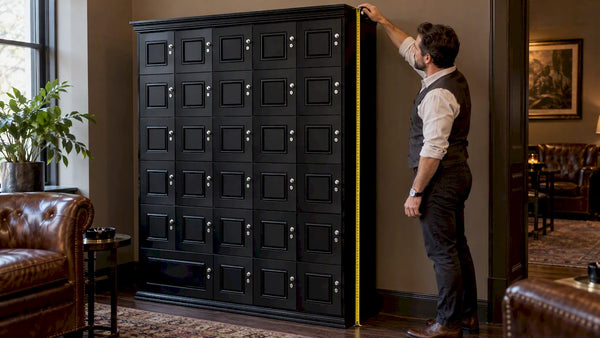
Cigar Locker Dimensions: Sizing Guide for Collectors and Lounges
Cigar locker dimensions explained: compartment sizes, cabinet footprints, capacity math and clearances, so you size a locker bank...
Read Article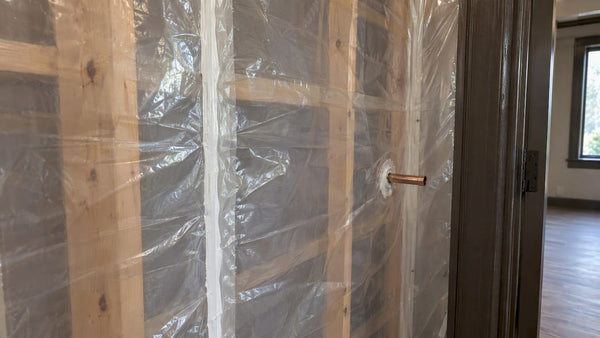
Sealing a Walk-In Humidor: Envelope, Door and Penetrations
How to seal a walk-in humidor properly: vapor barrier placement, door gasket, penetrations and the controlled airflow a...
Read Article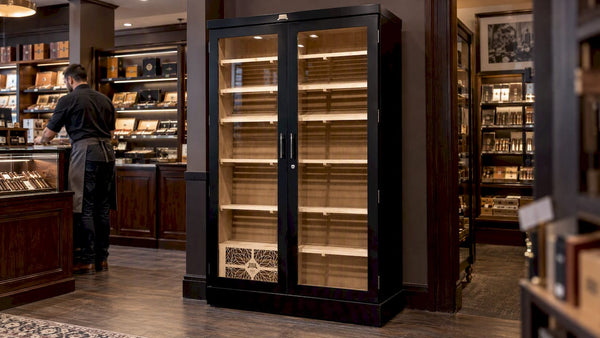
Retail Humidor ROI: How to Measure What a Display Earns
What does a retail or lounge humidor really return? A practical framework for cigar shops, lounges and clubs:...
Read Article