

Discover why rotate cigars in humidors every 2–4 weeks. Ensure even humidity, prevent mold, and age your collection perfectly.
TL;DR:
- Regularly rotating cigars every 2 to 4 weeks prevents uneven humidity and mold growth in humidors. This practice balances moisture, improves aging, and helps detect issues early across all storage zones. Proper rotation techniques and capacity management ensure consistent cigar quality and longevity.
Rotating cigars in your humidor every 2–4 weeks is the single most effective practice for maintaining even humidity exposure, preventing mold, and ensuring your collection ages with the consistency it deserves. Cigar rotation, as industry experts define it, is the deliberate repositioning of cigars within a humidor to counteract humidity gradients and stagnant air pockets. Without it, cigars near the humidification source absorb excess moisture while those at the far corners slowly dry out. Cigar expert Mike Glynn confirms that rotation every 2–4 weeks prevents localized drying and oversaturation across multi-layered and drawer-style humidors alike.
Why rotate cigars in humidors: the science of uneven humidity
Humidity inside a humidor does not distribute itself uniformly. Air stratifies, pools, and stagnates, creating micro-climates that vary significantly from one corner to the next. This is not a flaw in your humidor. It is a physical reality of any enclosed space where moisture moves passively.
The core problem is what specialists call “dead-air pockets.” These are zones where air circulation slows to near zero, allowing moisture to accumulate unchecked. Static storage creates micro-climates with trapped moisture where mold can form even when your hygrometer reads a perfectly acceptable relative humidity. That reading reflects an average, not a guarantee of uniformity.
The ideal relative humidity range for cigar storage is 65–70%. Maintaining that range at the hygrometer tells you nothing about what is happening in the back-left corner of your bottom drawer. A cigar resting directly beside a Spanish Cedar divider saturated with distilled water will experience conditions far wetter than one stored six inches away.
Several factors intensify humidity gradients inside a humidor:
- Proximity to the humidification source. Cigars within two inches of a humidifier or Boveda pack absorb significantly more moisture than those at the opposite end.
- Layering and drawer design. Multi-layer humidors trap heat and moisture at the bottom, creating a wetter lower zone and a drier upper zone.
- Ambient temperature variation. Humidors placed near windows or air vents experience external temperature swings that shift internal humidity unevenly.
- Wrapper leaf density. Thicker-wrapped cigars resist moisture absorption more than thinner-wrapped ones, meaning identical storage conditions produce different results across your collection.
Pro Tip: Place a secondary digital hygrometer at the far end of your humidor, away from the humidification source. If it reads more than 3% lower than your primary gauge, your collection needs more frequent rotation.
Internal air movement prevents isolated micro-climates from forming. Rotation is the most direct way to generate that movement in a passive storage environment.

How often should you rotate cigars, and what is the right technique?
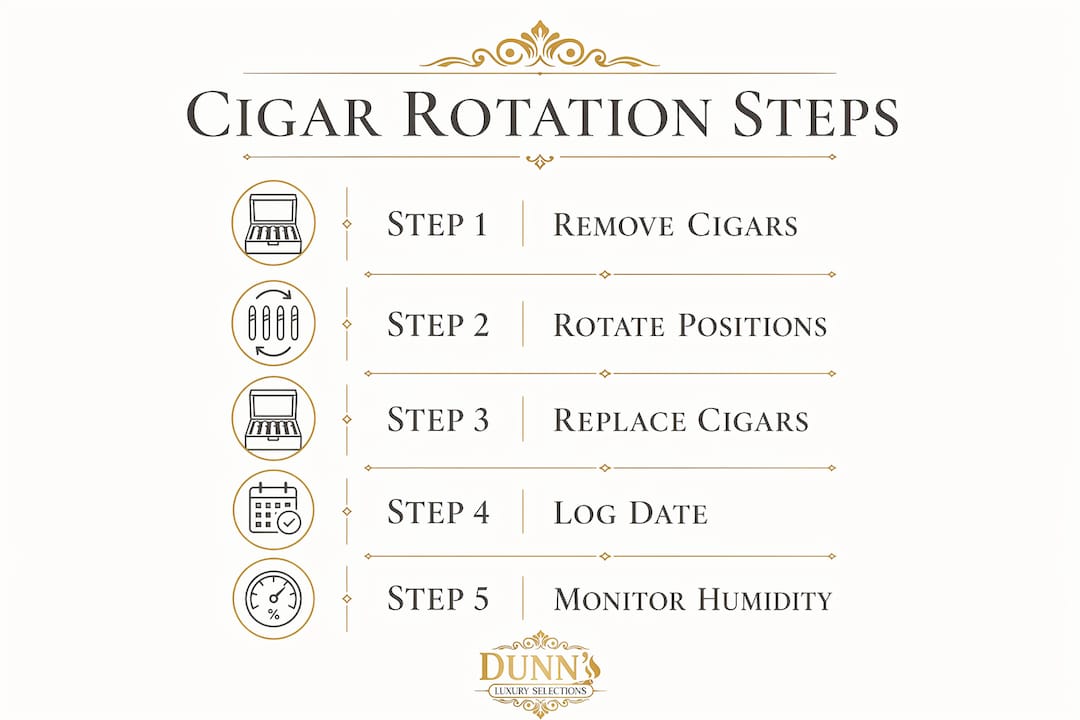
The 2026 expert consensus, led by voices like cigar authority Mike Glynn, places rotation frequency at every 2–4 weeks as the standard best practice. Collectors who store high-value aged cigars should lean toward the shorter interval. Those with a smaller, well-maintained desktop collection can comfortably rotate every four weeks.
Effective rotation is not simply shuffling cigars randomly. A deliberate method produces far better results.
- Move cigars from top to bottom layers. Cigars on the upper shelf experience drier, warmer air. Moving them to the lower position exposes them to the cooler, more humid zone, and vice versa. This exchange balances moisture absorption across the entire collection over time.
- Rotate cigars front to back. Cigars at the front of a drawer sit closer to the seal and experience slightly more air exchange when you open the humidor. Moving them to the back gives them a period of more stable, undisturbed rest.
- Reposition your humidification source. Moving a Boveda pack or crystal humidifier to the opposite end of the humidor during each rotation cycle distributes moisture more evenly over the following weeks.
- Inspect every cigar during rotation. Run your fingers gently along each wrapper. Soft spots indicate over-humidification. Cracking or brittleness signals drying. Rotation is your scheduled opportunity to catch problems before they spread.
- Segregate new arrivals before integrating them. Fresh cigars introduced without acclimation can spike local humidity and increase mold risk. Rest new additions in a separate tray or a dedicated travel humidor for one to two weeks before adding them to your main collection.
Pro Tip: Keep a simple log. Note the date of each rotation and any cigars that showed signs of moisture imbalance. After three months, patterns emerge that tell you exactly which zones in your humidor need the most attention.
Regular rotation also enhances cigar complexity and smoothness over time, beyond mere preservation. Uniform aging allows the tobacco’s natural oils to develop consistently across the entire leaf, producing a more balanced draw and finish.
How does humidor capacity affect the need for rotation?
Overcrowding a humidor is one of the most common mistakes serious collectors make. A humidor packed to capacity restricts passive airflow so severely that rotation becomes not just beneficial but critical to preventing damage.
The standard recommendation is to keep your humidor at no more than 80% of its rated capacity. That remaining 20% of open space is not wasted room. It is the breathing space that allows air to circulate between cigars, carrying moisture evenly throughout the interior.
The table below shows how capacity level affects airflow and the urgency of rotation:
| Capacity level | Airflow quality | Rotation urgency |
|---|---|---|
| Under 50% | Good passive circulation | Every 4 weeks |
| 50%–80% | Moderate, manageable | Every 2–3 weeks |
| Over 80% | Poor, restricted | Every 1–2 weeks |
| At full capacity | Near zero passive flow | Weekly, plus immediate reorganization |
A humidor packed to full capacity severely restricts passive airflow, making rotation exponentially more important. The internal air can no longer function as a unified, circulating system. Instead, it fragments into isolated pockets, each developing its own humidity level independent of your hygrometer reading.
Cabinet humidors with multiple shelves and trays offer a structural advantage here. Their vertical design promotes natural convection, where warmer air rises and cooler air settles, creating gentle passive circulation even without mechanical assistance. Desktop humidors, by contrast, rely almost entirely on rotation to compensate for their flat, single-layer design.
What are the risks of skipping cigar rotation?
Neglecting rotation in a well-stocked humidor is not a passive choice. It is an active decision to allow your collection to degrade unevenly, and the consequences compound over time.
The most immediate risk is mold. Air stagnation combined with moderate humidity drives mold growth, and periodic rotation disrupts the saturated dead-air pockets where moisture accumulates. Mold does not require excessively high humidity to establish itself. It requires only a localized zone where moisture sits undisturbed long enough to create the conditions it needs.
The second risk is flavor degradation. Uneven aging produces inconsistent flavor and burn irregularities. A cigar that has absorbed too much moisture from one side will draw unevenly, tunnel, or go out repeatedly. A cigar that has dried slightly on one end will crack during cutting and produce a harsh, acrid smoke. Neither outcome is acceptable for a collector who has invested in premium tobacco.
The third risk is the “newcomer spike.” Mixing fresh cigars with rested cigars without segregation creates localized humidity spikes that can affect every cigar in the immediate vicinity. A freshly purchased box of Nicaraguan puros, still carrying the moisture from the factory, placed directly into your collection can raise local humidity by several percentage points within 48 hours.
“Consistency is more crucial than perfection in humidity management. Rotation compensates for hygrometer inaccuracies and placement errors that even the most attentive collector cannot fully eliminate.” — Howard Environmental
The cost of neglect scales with the value of your collection. A single mold-affected cigar in a tightly packed humidor can contaminate its neighbors within days. For collectors curating aged Cubans, rare limited editions, or single-estate Dominicans, that risk is simply not acceptable. You can find additional guidance on preventing these issues in the Dunnluxuryselections care guides.
Some collectors also find value in pairing their cigar care routine with broader wellness practices. Resources on smoke shop accessories and wellness offer perspective on how the ritual of cigar enjoyment fits into a considered lifestyle.
Key Takeaways
Regular cigar rotation, performed every 2–4 weeks, is the most direct method for maintaining uniform humidity, preventing mold, and ensuring every cigar in your collection ages with the consistency that premium tobacco demands.
| Point | Details |
|---|---|
| Rotation frequency | Rotate every 2–4 weeks; high-value collections benefit from the shorter interval. |
| Capacity discipline | Keep humidors at or below 80% capacity to preserve passive airflow between rotations. |
| Mold prevention | Disrupting dead-air pockets through rotation stops mold before it establishes in localized zones. |
| New arrival protocol | Segregate fresh cigars for 1–2 weeks before integrating them to avoid local humidity spikes. |
| Rotation as inspection | Each rotation is a scheduled opportunity to detect mold, pests, or wrapper deterioration early. |
Rotation is the ritual that separates collectors from custodians
— Belle Dunn
I have handled hundreds of humidors over the years, from compact desktop units holding fifty cigars to walk-in sanctuaries curating thousands. The single most consistent difference I observe between collectors whose cigars age beautifully and those who open their humidors to disappointment is not the brand of humidor, not the quality of the humidification system, and not the price of the cigars. It is whether they rotate.
What surprises most collectors is how much rotation reveals. The first time you move every cigar in your humidor and actually handle each one, you will find things you did not know were there. A soft spot on a wrapper you thought was perfect. A faint white bloom on a cigar you added three months ago and forgot about. A humidification pack that has gone completely dry on one side while the other remains saturated. Rotation is not just maintenance. It is intelligence gathering.
The other insight I share with every serious collector is this: consistency matters more than perfection. Your hygrometer will never be perfectly accurate. Your humidor will never distribute humidity with mathematical precision. But if you rotate on a reliable schedule, you give every cigar in your collection an equal share of whatever conditions exist inside that sanctuary. You average out the imperfections. That is what uniform aging actually means in practice.
I also recommend treating rotation as a ritual rather than a chore. Pour yourself a measure of something worth drinking, open the humidor, and spend twenty minutes with your collection. Learn where your cigars are. Smell the interior. Check the Spanish Cedar lining for any sign of over-saturation. This is the kind of attention that transforms a storage box into a living collection.
— Belle Dunn
Humidors built for the way serious collectors actually store cigars
The principles behind effective rotation demand a humidor designed with airflow, capacity, and accessibility in mind. A sanctuary that makes rotation difficult is a sanctuary that will not be rotated consistently.

Dunnluxuryselections curates humidors built specifically for collectors who take preservation seriously. The Duke desktop humidor offers a routed-edge design with Spanish Cedar lining and a layout that makes biweekly rotation straightforward, even for a full collection. For collectors managing larger inventories, the Bermuda cabinet humidor provides the vertical shelving and generous capacity that supports proper airflow between rotation cycles. Every humidor in the Dunnluxuryselections collection is verified for craftsmanship and humidity performance before it reaches your hands.
FAQ
How often should you rotate cigars in a humidor?
Rotate cigars every 2–4 weeks as standard practice. Collectors storing high-value or aged cigars should rotate closer to the two-week mark to maintain the most consistent humidity exposure.
Can mold grow even when humidity reads correctly?
Yes. Static storage creates micro-climates with trapped moisture where mold can form even when the overall relative humidity reads within the ideal 65–70% range. Rotation disrupts these localized zones.
Do desktop humidors need rotation as much as cabinet humidors?
Even smaller desktop humidors benefit from biweekly rotation to prevent humidity pockets. Their flat, single-layer design offers no passive convection, making rotation the primary tool for humidity distribution.
What is the maximum recommended capacity for a humidor?
Keep your humidor at or below 80% of its rated capacity. Exceeding that threshold restricts passive airflow and makes humidity gradients significantly harder to manage, even with regular rotation.
Should you rotate the humidification source too?
Yes. Moving your humidification source, whether a Boveda pack, crystal humidifier, or electronic unit, to the opposite end of the humidor during each rotation cycle distributes moisture more evenly over the following weeks.
Recommended
You May Also Enjoy

Best Accio.com Alternatives for Luxury Cigar Humidors
Discover the best accio.com alternatives for luxury cigar humidors. Explore premium options for climate control and bespoke designs!
Read Article
Restoring Vintage Humidors: A Step-by-Step Process
Discover the step-by-step process for restoring vintage humidors. Bring your antique cigar storage boxes back to life and...
Read Article
Humidor Auction Preparation: A Collector's Expert Guide
Master the art of selling with this guide to humidor auction preparation. Ensure optimal condition and attract serious...
Read Article