

Learn what integrated humidification is and how it protects your premium cigars by maintaining ideal humidity and temperature effortlessly.
TL;DR:
- Integrated humidification provides precise climate control by automatically maintaining humidity within ±1–2% RH and regulating temperature. It uses sensors, fans, and moisture sources, ensuring even air distribution and reducing risks like mold, cracks, and beetle infestations. Proper maintenance, calibration, and seasoning are essential for long-term protection of valuable cigar collections.
Integrated humidification is defined as an active climate control system built directly into a cigar humidor to automatically maintain precise relative humidity and temperature without manual intervention. Unlike passive methods that rely on sponges, propylene glycol beads, or simple gel packs, an integrated humidification system uses sensors, fans, and moisture sources to hold conditions within ±1–2% RH. For collectors curating fine cigars worth thousands of dollars, that precision is the difference between a perfectly aged smoke and a ruined investment. Dunnluxuryselections has built its entire philosophy around this standard, recognizing that great cigars deserve a sanctuary engineered to protect them.
What is integrated humidification and how does it work?
An integrated humidification system works by continuously monitoring internal conditions and responding automatically when they drift from the target range. Internal sensors read both humidity and temperature in real time. When relative humidity drops below the set point, a control module activates a fan and triggers the moisture source, whether that is a water cartridge, ultrasonic mist generator, or evaporative pad. The result is a stable humidity environment that requires no guesswork from the collector.

Air circulation is a function that passive systems cannot replicate. Without active airflow, humidity pools near the moisture source and leaves dead zones at the far corners of the cabinet. Integrated systems use internal blower units or circulation fans to distribute conditioned air evenly across every shelf and every cigar. This even distribution prevents the localized mold or dryness that can silently destroy a collection over months.
Digital controls complete the picture. Most quality integrated units allow collectors to dial in a specific target, typically 65–70% RH, and then leave the system to manage itself. The set-and-forget operation is not a convenience feature. It is a preservation strategy. Humidity swings, even brief ones, cause wrapper leaves to expand and contract, cracking the leaf and compromising the draw.
- Sensors read humidity and temperature simultaneously, often using dual probes for redundancy.
- Control module processes sensor data and triggers the moisture source or fan as needed.
- Circulation fans move conditioned air to eliminate humidity pockets throughout the cabinet.
- Digital interface allows collectors to set targets and review logs without opening the humidor.
Pro Tip: Never rely on a single analog hygrometer inside an integrated unit. Pair the built-in digital sensor with a calibrated reference hygrometer placed at the opposite end of the cabinet to verify even distribution.
What are the benefits of integrated humidification over passive methods?
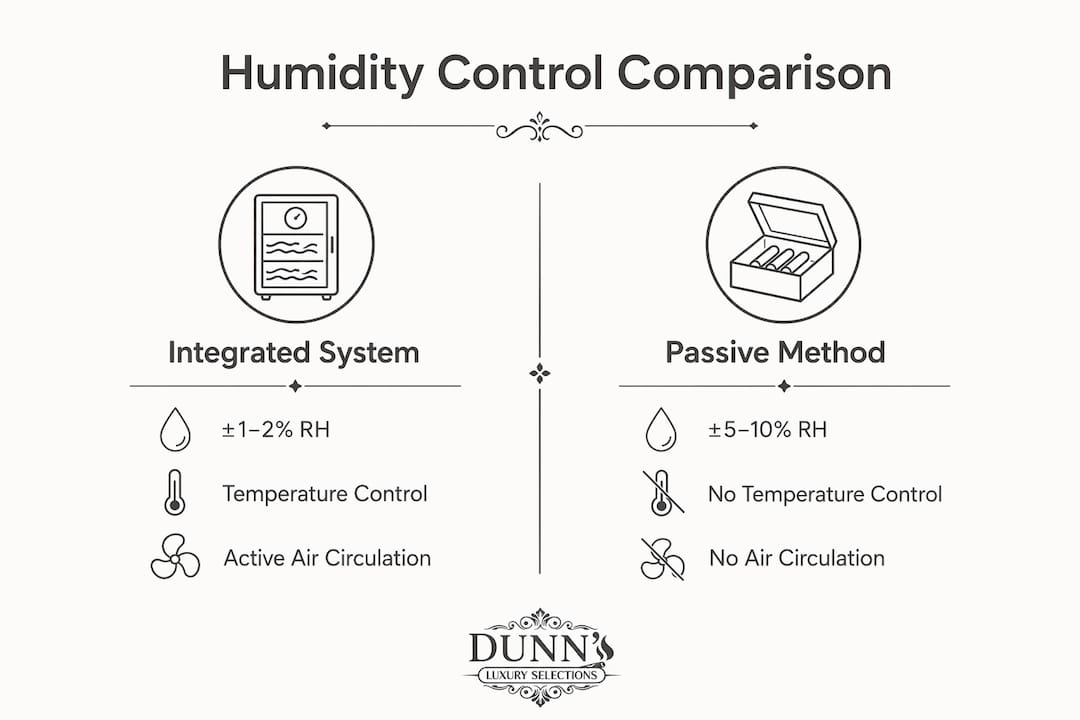
Passive humidification drifts by ±5–10% RH under normal conditions. An integrated electronic system holds within ±1–2% RH automatically. That gap is not a minor technical detail. It represents the margin between cigars that age gracefully and cigars that develop mold, crack, or lose their aromatic complexity entirely.
Temperature control is the benefit that passive systems cannot offer at all. Tobacco beetle eggs hatch at temperatures above 73°F, and a single infestation can destroy an entire collection. Integrated systems that include temperature management eliminate this risk by keeping the internal environment consistently below the threshold. Passive humidors, by contrast, are entirely at the mercy of the room they sit in.
Long-term aging beyond 18 months demands more than stable moisture. Ammonia released by aging tobacco must be vented or managed, or it accumulates and degrades the flavor profile of the cigars. Automated air quality management, including ammonia removal, is a feature exclusive to integrated systems. Passive methods offer no equivalent.
The investment protection argument is direct. Collections valued over $1,500 face catastrophic risk from beetle infestation or mold, which can destroy more than 50% of inventory in a single event. An integrated humidor eliminates that exposure.
| Feature | Integrated system | Passive method |
|---|---|---|
| Humidity precision | ±1–2% RH | ±5–10% RH |
| Temperature control | Active, automated | None |
| Air circulation | Internal fans | None |
| Ammonia removal | Automated | None |
| Maintenance frequency | Annual calibration | Weekly refilling |
| Long-term aging suitability | Excellent | Limited |
Pro Tip: Maintaining stable humidity at moderate levels, around 65–68% RH, protects better than chasing 70% RH. Integrated systems make that moderation effortless.
What types of integrated humidification technologies exist in premium humidors?
The technology inside an integrated humidification system varies by design, price tier, and intended collection size. Understanding the differences helps collectors match the right system to their storage needs.
Ultrasonic mist generators use piezo transducers vibrating at high frequency to atomize water into a fine mist without heat. This approach produces consistent moisture output and responds quickly to humidity drops. Advanced units adopt ultrasonic piezo transducers with dual sensors, bringing commercial-grade precision to cabinet and desktop humidors. The dual sensor logic cross-references two readings before triggering the system, virtually eliminating false activations.
Steam humidifiers heat water to produce vapor and are more common in large cabinet or walk-in configurations. They deliver high moisture output but consume more power and require distilled water to prevent mineral buildup on heating elements.
Water cartridge systems use a reservoir that the evaporative mechanism draws from passively or actively. They are simpler to refill and maintain, making them a practical choice for desktop and mid-size cabinet humidors.
| Technology | Best for | Key advantage | Maintenance note |
|---|---|---|---|
| Ultrasonic mist | Cabinet and desktop | Fast response, no heat | Use distilled water only |
| Steam | Walk-in and large cabinet | High output capacity | Descale heating element regularly |
| Water cartridge | Desktop and mid-size | Simple refilling | Replace cartridge every 30–60 days |
Air circulation mechanisms range from quiet centrifugal fans to multi-zone blower units in larger cabinets. Sensor technology has advanced significantly, with digital hygrometers now offering accuracy within ±1% RH when properly calibrated. Power considerations matter for built-in units. Ribbon cables routed through the humidor seal must be installed correctly to preserve airtightness. A compromised seal forces the system to work harder and shortens its operational life.
How to choose and maintain an integrated humidification system
Selecting the right system begins with matching capacity to collection size. A desktop unit managing 50–150 cigars has fundamentally different requirements than a cabinet holding 500–2,000 cigars. Undersizing the humidification system forces it to run continuously, accelerating wear and reducing lifespan.
- Assess your collection size. Count your current inventory and project growth over two to three years. Choose a system rated for at least 25% more capacity than your current count.
- Verify seal integrity before installation. Proper cable routing through the humidor seal is critical. Ribbon cables must pass through without creating gaps that allow moisture to escape and external air to enter.
- Season the Spanish cedar liner first. Unseasonded Spanish cedar will absorb moisture away from your cigars, causing humidity instability in the first weeks of operation. Season the wood by wiping the interior with distilled water and allowing it to stabilize for 48–72 hours before loading cigars.
- Calibrate sensors annually. Annual hygrometer calibration against a salt-test reference standard prevents sensor drift from producing false readings. A sensor reading 2% high will cause the system to under-humidify your collection for months before you notice.
- Monitor and troubleshoot proactively. If the system runs continuously without reaching the target humidity, check the water reservoir, inspect the seal, and verify that the Spanish cedar is fully seasoned. Continuous operation is the clearest early warning sign of a problem.
Pricing for integrated humidification units spans a wide range. Desktop systems with basic electronic controls represent the entry point, while cabinet and walk-in configurations with dual sensors, zonal climate control, and remote monitoring represent the upper tier. Expected lifespan for a quality integrated unit, with proper maintenance, exceeds ten years.
Pro Tip: Use only distilled water in ultrasonic and steam systems. Tap water introduces minerals that coat sensors and mist generators, degrading accuracy and output over time.
Key Takeaways
An integrated humidification system is the definitive solution for serious cigar collectors, holding humidity within ±1–2% RH and providing temperature control, air circulation, and ammonia management that passive methods cannot match.
| Point | Details |
|---|---|
| Precision humidity control | Integrated systems hold ±1–2% RH versus ±5–10% RH drift in passive methods. |
| Temperature and beetle protection | Active temperature management keeps conditions below the 73°F threshold where tobacco beetle eggs hatch. |
| Investment protection | Collections valued over $1,500 face 50%+ inventory loss risk from mold or beetles without active climate control. |
| Season Spanish cedar first | Unseasonded cedar absorbs moisture and destabilizes humidity in the critical first weeks of operation. |
| Annual sensor calibration | Hygrometer sensors drift over time; calibrate against a salt-test reference at least once per year. |
Why I stopped trusting passive humidification years ago
I have watched collectors spend $3,000 on a box of aged Nicaraguan puros and store them in a desktop humidor with a foam sponge. The logic is understandable. The cigars look fine. The hygrometer reads 68%. Everything appears controlled. Then summer arrives, the room temperature climbs, and the sponge cannot compensate fast enough. Within three weeks, the collection has swung between 58% and 76% RH. The wrappers crack. The draw tightens. The investment is diminished, not destroyed, but diminished in a way that cannot be reversed.
Passive humidification is not a failure of design. It is a tool built for a different purpose: short-term storage of modest collections in stable environments. The moment a collector begins aging cigars beyond 18 months, or the moment the collection crosses the threshold where a single bad event would cause genuine financial pain, passive methods become inadequate. The technology has simply not kept pace with what serious collectors need.
What I find most compelling about integrated systems is not the precision, though ±1–2% RH is genuinely impressive. It is the removal of anxiety. A collector who trusts their environment does not open the humidor unnecessarily, does not second-guess the hygrometer, and does not lose sleep during a heat wave. That peace of mind has real value, and it compounds over years of aging.
The pairing of technology with traditional craftsmanship matters deeply. Spanish cedar is not a relic of old-world humidor making. It is the best material available for regulating micro-humidity around individual cigars, absorbing and releasing moisture in a way that synthetic liners cannot replicate. An integrated system and properly seasoned Spanish cedar work together as a perfectly balanced ecosystem. Neither is sufficient alone. Together, they create the conditions where a fine cigar can become something extraordinary over time.
My advice to any serious collector is to view integrated humidification not as a luxury upgrade but as the baseline standard for protecting what you have built.
— Belle Dunn
Premium integrated humidors at Dunnluxuryselections
Dunnluxuryselections offers a curated selection of humidors built around active climate control, from desktop sanctuaries to full cabinet configurations designed for substantial collections.

The Humidor Supreme 9200 Series delivers double-door access and electronic humidity management within ±1–2% RH, making it the right instrument for collectors who refuse to compromise on precision. For collectors building a larger sanctuary, the Bermuda Cabinet Humidor provides advanced integrated humidification and temperature stability across a generous capacity. Every unit in the Dunnluxuryselections catalog is tested for authenticity and backed by expert consultation, so you invest with confidence from the first cigar to the last.
FAQ
What is integrated humidification in a cigar humidor?
Integrated humidification is an active climate control system built into a humidor that uses sensors, fans, and a moisture source to automatically maintain humidity within ±1–2% RH. It replaces manual passive methods like sponges or beads with automated, set-and-forget precision.
How does an integrated humidification system differ from passive methods?
Passive systems drift by ±5–10% RH and offer no temperature control or air circulation. Integrated systems hold ±1–2% RH, actively manage temperature, circulate air to eliminate humidity pockets, and can remove ammonia produced by aging tobacco.
Why is Spanish cedar still important with an integrated humidifier?
Spanish cedar must be seasoned before use even with an active humidifier. Unseasonded cedar absorbs moisture away from cigars, causing humidity instability until the wood reaches equilibrium. Proper seasoning takes 48–72 hours with distilled water.
How often should I calibrate my integrated humidor’s sensors?
Annual calibration against a salt-test reference standard is the recommended minimum. Sensor drift causes the system to misread conditions and under-humidify or over-humidify the collection without any visible warning sign.
What collection size justifies an integrated humidification system?
Collections valued over $1,500 or intended for aging beyond 18 months justify an integrated system. Beetle infestation or mold in a passive humidor can destroy more than 50% of inventory in a single event, making active climate control a sound protection for any serious collection.
Recommended
You May Also Enjoy

Best Accio.com Alternatives for Luxury Cigar Humidors
Discover the best accio.com alternatives for luxury cigar humidors. Explore premium options for climate control and bespoke designs!
Read Article
Restoring Vintage Humidors: A Step-by-Step Process
Discover the step-by-step process for restoring vintage humidors. Bring your antique cigar storage boxes back to life and...
Read Article
Humidor Auction Preparation: A Collector's Expert Guide
Master the art of selling with this guide to humidor auction preparation. Ensure optimal condition and attract serious...
Read Article