

Discover the truth behind markings found on cigars. Learn to differentiate between harmless plume and harmful mold to protect your collection.
TL;DR:
- Most visible markings on a cigar are either harmless wrapper flaws or mold, with fuzzy and colored growth indicating mold. Lab tests reveal fungal species in all samples labeled as plume, so default to treating such markings as mold unless confirmed otherwise. Proper inspection, immediate quarantine of uncertain cigars, and precise storage conditions significantly reduce mold risk and prevent wrapper blemishes.
Most white or colored markings on a cigar are either harmless wrapper faults or active mold. Treat any fuzzy, colored, or foot growth as mold until proven otherwise. That single rule protects your collection from a contamination cascade that can ruin dozens of sticks in days.
The distinction that matters most is between plume (also called bloom) and mold. Plume is a rare, flat, powdery dusting of crystallized oils that collectors occasionally find on long-aged cigars. Mold is a living fungal colony. Lab testing of collector-submitted samples found fungal species, including Eurotium amstelodami and Aspergillus, in every sample tested, even in cases where collectors were confident they were looking at plume. That finding alone justifies a conservative default.
Quick checks to run right now:
- Texture: Flat and powdery suggests plume; raised, fuzzy, or three-dimensional means mold.
- Color: Plain white or pale gray may be plume; any green, blue, yellow, or black tint is mold.
- Pattern: Even, uniform dusting leans toward plume; clustered spots or colonies indicate mold.
- Foot check: Any growth on the foot of the cigar is always mold, without exception.
- Smell: A musty or damp odor confirms mold; a neutral or faintly sweet smell is inconclusive.
Pro Tip: When you cannot make a confident call within 30 seconds of inspection, isolate the cigar immediately. Uncertainty is itself a reason to quarantine.
Table of Contents
- What are the common markings found on cigars?
- How do you tell plume apart from mold?
- What causes non-fungal wrapper blemishes?
- What should you do when you find growth or stains?
- How do you prevent wrapper markings through proper storage?
- Key Takeaways
- The collector’s honest view on markings and risk
- Precision storage that prevents markings before they start
- Useful sources
- FAQ
What are the common markings found on cigars?
Understanding what you are looking at requires separating three distinct categories: fungal growths, natural wrapper stains, and pigment faults rooted in the curing barn. Each has a different cause, a different risk level, and a different response.
Plume (bloom)
Plume is the rarest of the three. Collectors describe plume as a fine, even, powdery white or pale gray dusting. However, lab testing found fungal species in every collector-submitted plume sample, so the safe default is to treat such markings as mold unless laboratory confirmation is obtained. Retailer guidance notes plume as flat surface crystallization that brushes off cleanly, but genuine plume is rare and uncertain without lab evidence.
Mold
Mold is three-dimensional. It grows upward from the wrapper surface, often in clustered colonies, and can present in white, green, blue, yellow, or black. Practical retailer inspection rules describe mold as fuzzy or spotty, frequently accompanied by a musty or damp smell, and capable of leaving a stain on the wrapper after wiping. Mold spreads. A single infected cigar left in a humidor can contaminate an entire collection within days.
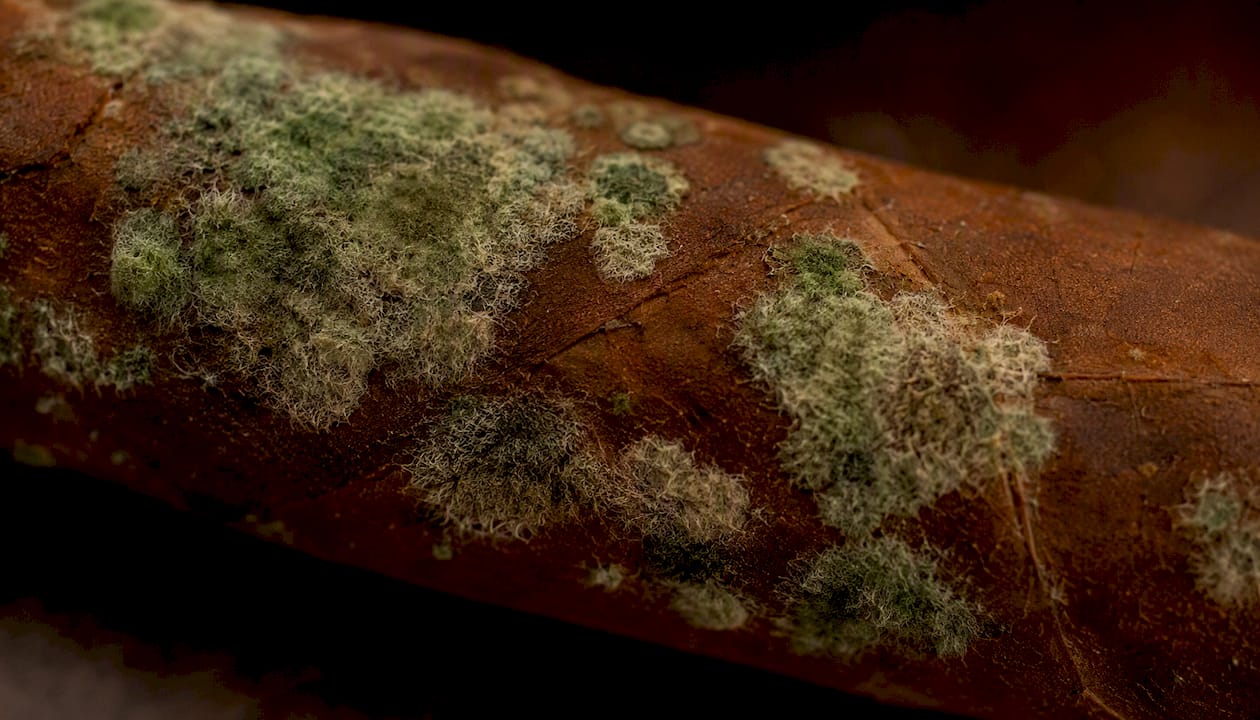
Non-fungal wrapper stains
Cigar Journal’s detailed analysis links most colored wrapper stains directly to curing and fermentation conditions rather than post-production contamination. These stains are usually permanent pigment faults in the leaf itself.
| Marking | Appearance | Likely Cause | Smoke Impact |
|---|---|---|---|
| Plume/bloom | Flat, even white/gray powder | Nearly always mold (per lab testing) | Quarantine unless confirmed otherwise |
| White mold | Fuzzy white spots or colonies | Fungal growth (excess humidity) | Discard or quarantine |
| Green mold | Green fuzzy patches | Fungal growth | Discard |
| Green stain | Flat green patches (“frog eyes”) | Incomplete chlorophyll breakdown during drying | Usually cosmetic |
| Yellow stain | Pale yellow areas | Insufficient humidity during curing | Minor wrapper fault |
| Black stain | Dark patches | Excessive humidity during drying | Possible burn/taste effect |
| Water spots | Pale circular blemishes | Moisture exposure during curing or transit | Cosmetic |
| Sun/bleach spots | Faded, irregular pale areas | Light exposure during field growth | Cosmetic |
Key distinction: Stains are flat and permanent. Mold and plume sit on the surface and respond to touch. That tactile difference is your first and fastest diagnostic.
How do you tell plume apart from mold?
A reliable inspection takes less than two minutes. Run through these steps in order, and you will have a defensible answer in almost every case.
-
Set up good light and magnification. Use a phone camera zoomed to 3x or a jeweler’s loupe. Ambient light alone misses early-stage mold colonies that are clearly visible under magnification.
-
Perform the texture test. Gently press a clean fingertip near (not on) the growth and observe. Plume lies flat against the wrapper; mold stands up from it. If the growth has any three-dimensional height, treat it as mold.
-
Assess color and pattern. Any tint beyond plain white or pale gray strongly indicates mold. Even white growth that appears in clustered spots rather than an even dusting across the body should be treated as mold. Distinguishing rules from retailer inspection guides consistently flag pattern irregularity as a mold indicator.
-
Check the foot. Turn the cigar and examine the cut or uncut foot. Growth on the foot is always mold. The foot’s exposed filler provides an ideal environment for fungal colonization, and plume does not form there.
-
Smell the cigar. Hold it close and inhale. A musty, damp, or earthy odor confirms mold. A neutral or faintly sweet tobacco smell is not conclusive proof of plume, but it reduces urgency.
-
Perform the brush/wipe test. Using a clean, dry cloth or a soft brush, gently wipe the affected area. Plume brushes away completely and leaves no mark. Consumer inspection guidance notes that mold, after wiping, often leaves a stain or discoloration on the wrapper. If a stain remains, the cigar has mold.
Pro Tip: For high-value or rare cigars, skip the wipe test entirely and go straight to quarantine. The risk of spreading spores to your hands and then to other sticks outweighs any benefit of confirming the diagnosis on a single cigar.
What causes non-fungal wrapper blemishes?
Not every mark on a wrapper signals danger. Many of the most common wrapper blemishes originate in the tobacco field or curing barn, long before the cigar reaches your humidor. Understanding their origins helps you separate cosmetic imperfections from genuine threats.
-
Green patches (“frog eyes”): These flat, pale green spots result from incomplete chlorophyll breakdown during the drying process. Field conditions and microclimates in the curing barn are the primary cause, particularly when leaves fold against each other and block airflow. Taste is generally unaffected. You can smoke a cigar with green patches without concern.
-
Yellow stains: Yellow discoloration on a wrapper typically indicates that the leaf was cured under insufficient humidity. Cigar Journal identifies this as a curing fault that produces a lower-grade leaf classification. The stain is permanent and cosmetic, though it signals the wrapper was not ideal to begin with.
-
Black stains: Darker pigmentation, sometimes appearing as black or very dark brown patches, results from excessive humidity during the drying phase. The elevated moisture causes sugar retention in the leaf, which darkens during fermentation. This can occasionally affect burn consistency and flavor, though many collectors report no perceptible difference.
-
Water spots and sun spots: Circular pale blemishes from moisture exposure during curing or transit, and faded irregular patches from light exposure in the field, are both cosmetic. These marks are permanent pigment faults in the leaf itself, not surface contamination. They do not spread and require no action beyond noting the wrapper grade.
-
Vein marks: Prominent veins are a structural feature of the leaf, not a fault. Heavier veins can affect draw in some cases, but they carry no hygiene risk.
The critical rule: if a blemish is flat, permanent, and does not respond to touch, it is almost certainly a curing or pigment fault. If it has texture, responds to touch, or appeared recently in storage, treat it as a potential fungal issue until you confirm otherwise. Understanding how wrapper origin and leaf selection affect appearance helps collectors separate natural variation from damage.
What should you do when you find growth or stains?
Speed matters. A single moldy cigar left in a humidor can spread spores to every stick in the box within 48 hours. The moment you spot suspicious growth, act.
Immediate steps:
- Remove the affected cigar from the humidor without touching other sticks.
- Place it in a sealed zip-lock bag or a dedicated quarantine container.
- Wash your hands before handling any other cigars.
- Do not return the cigar to the humidor until you have completed a full inspection.
Decision flow:
| What you see | Action |
|---|---|
| Flat, even white dust, no stain after wiping | Wipe clean with a dry cloth; monitor closely for 48 hours |
| Small isolated white spots, no color, no foot growth | Quarantine; inspect daily for 5–7 days before returning |
| Fuzzy growth of any color | Discard; do not smoke |
| Any growth on the foot | Discard immediately |
| Musty smell with or without visible growth | Quarantine all cigars from the same box |
Sanitizing your humidor:
Remove all cigars and place them in a clean, sealed container. Empty the humidor completely, including any cedar trays or dividers. Wipe the interior with a cloth lightly dampened with isopropyl alcohol, then allow it to air dry fully, at least 24 hours, before re-seasoning. Re-season using distilled water or a propylene glycol solution to bring the interior back to your target relative humidity. Cedar dividers and interior materials can harbor spores, so inspect them carefully and replace any that show visible mold.
If the contamination was widespread, affecting multiple cigars across different areas of the humidor, consider a professional consultation before restocking. Persistent mold recurrence often signals a deeper humidity control problem rather than a one-time contamination event.
How do you prevent wrapper markings through proper storage?
Prevention is where storage quality pays its most direct dividend. The conditions that produce mold and wrapper faults are predictable and, with the right humidor, largely avoidable.
Relative humidity targets: Industry guidance consistently points to 65–72% RH as the optimal long-term storage range for most cigars. Collector-facing FAQ guidance notes that mold risk rises when humidity exceeds approximately 70–80% RH for extended periods. Staying within the lower half of the safe window gives you a meaningful buffer against mold while preserving the oils and moisture content that keep wrappers supple.
Temperature and airflow: Stable temperature, ideally between 65°F and 70°F, reduces condensation on the interior walls and on wrapper surfaces. Gentle air circulation, whether from a built-in fan or periodic rotation of stock, prevents localized humidity pockets where mold colonies establish first.
Hygrometer calibration and humidification media: A hygrometer that reads 2–3% high or low is not a minor inconvenience; it is a direct mold risk. Calibrate your hygrometer regularly using the salt test method. For humidification, distilled water or a propylene glycol solution prevents mineral buildup and bacterial growth in the humidification device. Cedar sheets and their interaction with humidity are worth understanding, as properly seasoned Spanish cedar actively buffers RH fluctuations.

Quarantine new arrivals: Inspect every new cigar before it enters your main humidor. A short quarantine of 5–7 days in a separate container lets you catch any mold introduced during shipping before it reaches your collection. Humidity swings during transit are a documented trigger for both surface crystallization and fungal growth.
Rotate your stock: Cigars sitting in one position for months develop uneven humidity exposure. Rotating stock every few weeks distributes moisture evenly and gives you a regular opportunity to inspect for early-stage markings.
| Storage type | RH precision | Mold risk level | Best for | Prevention advantage |
|---|---|---|---|---|
| Desktop humidor | ±3–5% RH (passive) | Moderate | Small collections, up to 150 cigars | Affordable entry; requires frequent monitoring |
| Cabinet humidor | ±1–3% RH (passive/active) | Low to moderate | Mid-size collections, 150–1,000 cigars | Cedar lining buffers swings; better airflow |
| Electronic cabinet | ±1–2% RH (electronic) | Low | Large or high-value collections | Precise control; integrated fans reduce hot spots |
| Walk-in humidor | ±1% RH (zonal climate control) | Very low | Commercial, club, or estate collections | Full environmental control; eliminates condensation risk |

Key Takeaways
The single most important rule for any collector: fuzzy, colored, or foot growth is mold; flat, even white dust might be plume but is still uncertain without lab confirmation. Default to caution.
| Point | Details |
|---|---|
| Assume mold when uncertain | Lab testing found fungal species in every collector-submitted “plume” sample; the safe default is always mold. |
| Use the five-step inspection | Check texture, color, pattern, foot, and smell before touching; wipe only if growth is flat, white, and leaves no stain. |
| Act immediately on discovery | Isolate the affected cigar, wash hands, and inspect all sticks from the same box before returning anything to the humidor. |
| Keep RH at 65–72% | Storage above approximately 70–80% RH raises mold risk; staying in the lower range provides a meaningful buffer. |
| Dunnluxuryselections for precision storage | Electronic and cabinet humidors from Dunnluxuryselections hold ±1–2% RH with cedar interiors, directly reducing the conditions that produce mold and wrapper faults. |
The collector’s honest view on markings and risk
There is a version of this conversation that ends with “when in doubt, throw it out,” and while that advice is technically correct, it does not reflect how serious collectors actually think about their inventory.
The truth is that risk tolerance in cigar collecting is personal and proportional. A collector who spots a faint white dusting on a five-year-old Nicaraguan from a trusted source will often wipe it, smell it, and smoke it, because the visual evidence leans toward plume and the downside of being wrong is a single cigar. That same collector, faced with the same marking on a 15-year-old Cuban box that represents a significant portion of their cellar’s value, will quarantine without hesitation.
What separates experienced collectors from anxious ones is not certainty about every mark. It is a consistent inspection habit that catches problems early, before a single questionable stick becomes a humidor-wide contamination event. Regular visual checks, a calibrated hygrometer, and a dedicated quarantine container cost almost nothing compared to the alternative.
The deeper issue, one that most identification guides skip, is that mold recurrence is almost always a storage problem, not a cigar problem. A high-quality humidor with precise RH control and a cedar interior does not eliminate mold risk entirely, but it removes the conditions that make mold a recurring threat. Collectors who invest in proper storage spend far less time diagnosing markings than those who rely on passive, imprecise humidification. Record-keeping for rare or aged boxes, noting acquisition date, storage conditions, and any observed markings, adds a layer of provenance protection that matters when the collection grows in both size and value.
Precision storage that prevents markings before they start
The most reliable way to reduce the frequency of markings in your collection is to remove the conditions that produce them. Dunnluxuryselections offers a curated range of storage solutions built around the ±1–2% RH precision threshold that separates a true sanctuary for fine cigars from a box that merely holds them.

From the Duke desktop humidor for collectors with a focused, carefully curated selection, to the Humidor Supreme 9200 Series Double-Door Electronic Humidor for those managing a serious collection with active climate control, every piece in the Dunnluxuryselections catalog is chosen for its ability to hold humidity precisely and consistently. The Bermuda Cabinet and the Mahogany Cigar Locker Humidor address larger collections and club environments where segregated storage and Spanish cedar interiors do the quiet work of mold prevention every day. For collectors who want the full picture on cabinet options, the 17-Lockers Cigar Humidor Cabinet and the Santiago Cigar Humidor offer locker-style separation and presentation-grade craftsmanship in equal measure.
Browse the full Dunnluxuryselections humidor collection or contact the team directly for a bespoke consultation on the storage solution that fits your collection’s scale and ambition.
Useful sources
The following references informed this guide and offer deeper reading, photographs, and lab evidence for collectors who want to go further.
- Cigar Plume vs Mold: Is Plume Real? (2026) · Cigarista
- Stains on Cigar Wrappers: Green, Yellow, Black and White Spots Explained | Cigar Journal
- White Spots on Cigars — What Are They? | Holt’s Clubhouse
- Cigar Plume vs Mold — JR University | JR Blending Room | JR Cigars
- Cigar Wrapper Discolouration Explained | Green, Yellow, Black & White Stains
- Natural blemishes | MBCigar
- Wrapper Issues: Mold, Bloom, and Spots | CigarFan
- Cigar FAQ | Cigar Inspector
For a bespoke humidor consultation tailored to your collection, contact Dunnluxuryselections directly through the journal and resources page.
FAQ
What is the difference between plume and mold on a cigar?
Plume is described as a flat, powdery white or gray dusting of crystallized oils, but lab evidence shows such markings nearly always contain fungal species. Mold is three-dimensional, often fuzzy, can appear in multiple colors, and leaves a mark after wiping.
How do you spot a bad cigar?
Look for fuzzy or colored growth anywhere on the wrapper, any growth on the foot, a musty smell, or soft spots indicating uneven moisture. Any of these signs warrants isolation before smoking.
What are the small white spots on Cuban cigars?
Small white spots on Cuban cigars should be treated as mold and the cigar quarantined, since lab testing found fungal species in every collector-submitted white-spot sample.
How do you tell if a cigar is real or counterfeit?
Authentic cigars carry consistent band markings, cigar identification symbols, and cigar brand identification details that align with the manufacturer’s known production. Counterfeits often show inconsistent printing, misaligned bands, or wrapper colors that do not match the declared origin. Comparing cigar band markings against verified examples from the manufacturer or a trusted retailer is the most reliable check.
What humidity level prevents mold in a humidor?
Keeping relative humidity between 65% and 72% RH provides the best balance between preservation and mold prevention. Collector guidance notes that sustained humidity above approximately 70–80% RH raises mold risk meaningfully.
Recommended
You May Also Enjoy

Cigar Locker Dimensions: Sizing Guide for Collectors and Lounges
Cigar locker dimensions explained: compartment sizes, cabinet footprints, capacity math and clearances, so you size a locker bank...
Read Article
Sealing a Walk-In Humidor: Envelope, Door and Penetrations
How to seal a walk-in humidor properly: vapor barrier placement, door gasket, penetrations and the controlled airflow a...
Read Article
Retail Humidor ROI: How to Measure What a Display Earns
What does a retail or lounge humidor really return? A practical framework for cigar shops, lounges and clubs:...
Read Article