

Explore the four main cigar rolling styles—entubado, book, accordion, and Lieberman method—to enhance your smoking experience and skills.
TL;DR:
- Cigar rolling techniques like entubado, accordion, book, and machine-assisted bunching create different internal structures affecting airflow and flavor. The choice of method impacts burn quality, production speed, and storage needs, especially for premium cigars. Proper storage in a stable, cedar-lined humidor preserves the intricate architecture and enhances the smoking experience.
The four primary cigar rolling styles are entubado (tube-style), accordion, book (stack-and-roll), and machine-assisted bunching via the Lieberman method. Each defines the cigar’s internal architecture before a single wrapper leaf is applied, and that architecture dictates everything from draw resistance to flavor transport. For collectors and hobbyists alike, understanding these different cigar rolling techniques is the first step toward appreciating what separates a transcendent smoke from a merely adequate one.
The verdict in one sentence: choose entubado when flavor and airflow are the priority, book bunching when you want speed and consistency, accordion when you need a middle ground, and the Lieberman method when production volume matters more than artisanal distinction.
Core trade-offs at a glance:
- Entubado — airflow and flavor, slower output
- Book — speed and consistency, slightly denser draw
- Accordion — balanced draw, moderate skill requirement
- Lieberman/machine-assisted — semi-mechanized efficiency, operator-dependent quality
Pro Tip: Before you attempt any rolling method at home, condition your filler leaves overnight in a humidified environment at 65–70% relative humidity. Dry leaves crack; over-wet leaves mold. Neither produces a cigar worth smoking.
Table of Contents
- How the main cigar rolling styles compare side by side
- Entubado bunching: the technique that torcedores prize most
- Book bunching: the workhorse method for handmade cigars
- Accordion bunching: balanced draw without sacrificing productivity
- Tubing vs. entubado: clarifying a naming confusion
- Machine-assisted bunching: what the Lieberman method actually does
- Tools and materials every hobbyist needs before rolling at home
- Common defects, their causes, and how to fix them
- How to practice book bunching and simplified entubado at home
- Why bunching method matters: the evidence behind airflow and flavor
- Key Takeaways
- What most hobbyists get wrong about rolling and storage
- Preserve what the torcedor built: Dunnluxuryselections humidors for serious collectors
- Further reading and authoritative sources
- FAQ
How the main cigar rolling styles compare side by side
The bunching method is what defines the type of cigar, according to Tobacconist University’s Tobacco College curriculum. Wrapper application is largely consistent across methods; bunching is where the real divergence happens.
| Method | Airflow & combustion | Flavor delivery | Labor/production | Skill difficulty | Best used for |
|---|---|---|---|---|---|
| Entubado (tubular) | Excellent — open channels per leaf | Maximum aromatic transport | Slow (limited daily output) | High | Premium handmade lines |
| Accordion | Good — fold passages aid draw | Above average | Moderate (200–250/day) | Medium | Mid-premium handmade |
| Book (stack-and-roll) | Adequate — denser pack | Consistent, slightly muted | Fastest for handmade | Low-medium | Factory handmade, hobbyist practice |
| Lieberman/machine | Consistent but uniform | Reliable, less nuanced | High volume | Low (operator) | Semi-handmade, production |
To identify a cigar’s likely bunching style from a cut end, look at the cross-section. Entubado-bunched cigars show distinct circular or oval leaf scrolls. Accordion-bunched cigars reveal a fan-like layering. Book-bunched cigars present a more uniform, compressed stack. Machine-bunched examples often appear perfectly symmetrical, almost too uniform to be hand-formed.
- Entubado cross-section: visible individual scrolls, open channels between leaves
- Accordion cross-section: layered folds, slight wave pattern
- Book cross-section: flat, stacked, tightly compressed
- Lieberman cross-section: highly uniform, consistent diameter throughout
Entubado bunching: the technique that torcedores prize most
Entubado is the tubular method where each filler leaf is individually scrolled into a cylinder before the leaves are assembled into a bunch. Smoke passes through and around each scroll, carrying more aromatics with it, which produces a cooler, slower, and more even burn than any other hand-rolling method.

A skilled torcedor forms each scroll by laying a single filler leaf flat, then rolling it lengthwise into a tight tube with fingertips, not palms. The scrolls are then assembled in deliberate order: lighter volado leaves toward the foot to ease ignition, with stronger ligero leaves positioned near the center where heat builds during the smoke. This arrangement is not incidental. It modulates flavor progression, delivering a gradual intensity increase from first third to final third.
For collectors inspecting a cut cigar, the telltale signs of entubado are those visible scrolls at the cut end and a noticeably open, effortless draw. The burn tends to be even and slow, and the cigar runs cooler than a book-bunched equivalent of the same size. Premium lines from Cuba, Nicaragua, and the Dominican Republic frequently use entubado precisely because it maximizes what the filler leaves have to offer aromatically.
The production trade-off is real. Entubado rollers produce a relatively low number of cigars per day, compared to 200–250 for accordion and more for book. That slower pace is why entubado is reserved for premium lines where the price point justifies the labor investment.
“The torcedor’s word translates as ‘twister,’ but twisting is the last thing a cigar roller should do when making a cigar. Parallel compression, not rotation, is what preserves the internal architecture and the draw.” — Habanos, S.A. Official Glossary
Pro Tip: When practicing entubado, roll each filler leaf scroll loosely enough that you can slide a toothpick through the center. Too tight and you lose the airflow advantage entirely; too loose and the bunch collapses under the binder.
Book bunching: the workhorse method for handmade cigars
Book bunching stacks filler leaves flat, one on top of another, then folds the entire stack like closing a book before applying the binder. It is the fastest handmade bunching method and the most forgiving for beginners, which is why factories worldwide rely on it for consistent output.
The sequence runs like this:
- Lay filler leaves flat, aligning the stems as closely as possible.
- Stack 3–5 leaves in the desired blend ratio, with the strongest leaf in the center.
- Fold the stack in half lengthwise, as you would close a book.
- Roll the folded stack into a cylinder and apply the binder leaf from foot to head.
- Place the bunched cigar into a mold and press for at least 30–45 minutes, turning at intervals to prevent ridging.
The internal structure is denser than entubado, which affects draw. Book-bunched cigars tend to have a slightly firmer draw and a more uniform, if less nuanced, flavor profile. The leaves are not individually scrolled, so smoke does not travel through each leaf independently. The result is reliable and consistent, but the aromatic ceiling is lower.
For hobbyists, book bunching is the correct starting point. The technique is forgiving of minor leaf imperfections, and the mold press compensates for small inconsistencies in compression. Once you can produce five consecutive book-bunched cigars with an even draw and no hard spots, you are ready to attempt entubado.
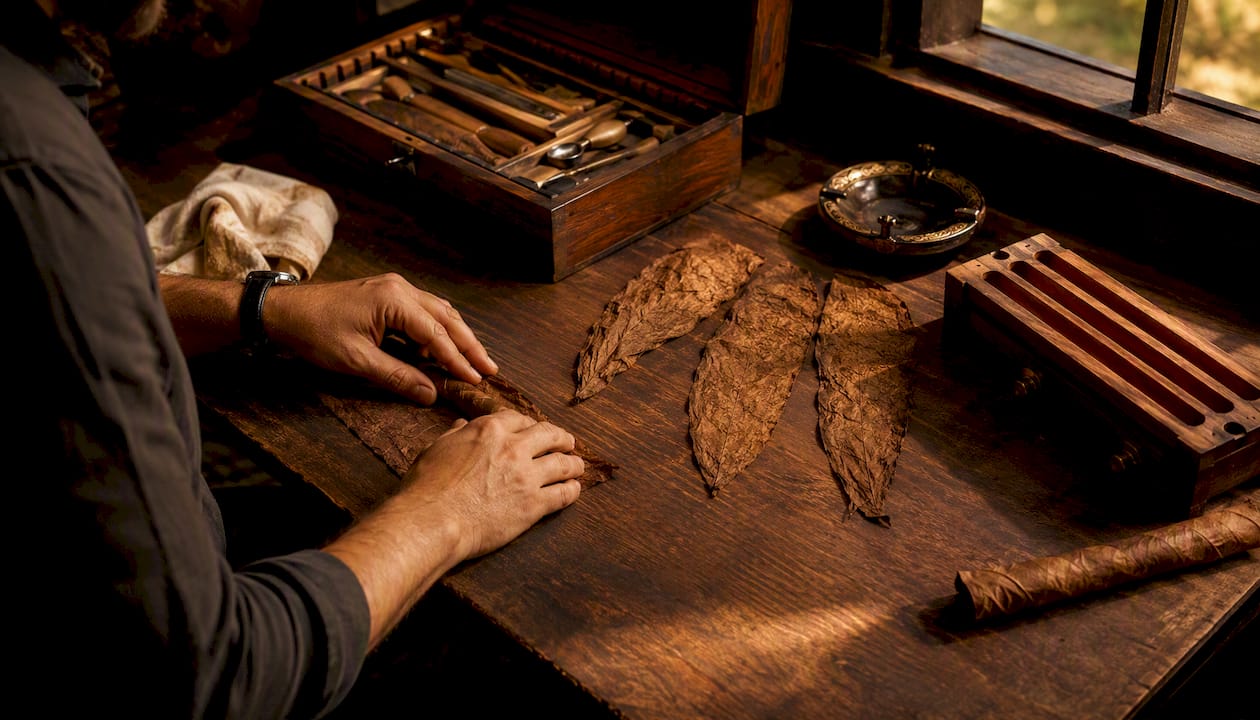
Pro Tip: When applying the binder, maintain steady tension from foot to head without stretching the leaf. A stretched binder creates thin spots that crack during the pressing cycle, which ruins the cigar’s structural integrity before the wrapper even goes on.
Accordion bunching: balanced draw without sacrificing productivity
Accordion bunching folds each filler leaf inward like a fan, creating a series of passages through which smoke travels. The result sits between entubado and book in both airflow quality and production speed, which explains why many mid-premium manufacturers favor it when entubado’s labor cost is prohibitive but book bunching’s density is unacceptable.
The fold pattern creates natural channels that improve draw over a book-bunched cigar without requiring the individual scrolling of entubado. Smoke moves through the folds, picking up aromatics from multiple leaf surfaces simultaneously. The flavor delivery is above average, though not quite as nuanced as a well-executed entubado.
- Airflow advantage: fold passages reduce draw resistance compared to book bunching
- Flavor benefit: smoke contacts more leaf surface area than in a flat-stacked book bunch
- Production speed: moderate, roughly 200–250 cigars per day
- Fragility point: the fold stress points are vulnerable during pressing; excessive mold pressure can collapse the folds and negate the airflow benefit
- Best format: works particularly well in larger ring gauges where the folds have room to maintain their shape
Manufacturers choose accordion over entubado when the cigar’s blend calls for a reliable, consistent draw across a large production run. It is also the preferred method for certain Honduran and Nicaraguan factories producing mid-range premium lines where value and quality must coexist.
Tubing vs. entubado: clarifying a naming confusion
Tubing is often used as a synonym for entubado, but the term is applied inconsistently across regions and vendors, which creates genuine confusion for hobbyists trying to learn from multiple sources.
In most American cigar education contexts, “tubing” refers to the same technique as entubado: individually scrolling each filler leaf into a tube before assembly. In some Caribbean and Central American factory contexts, however, “tubing” describes a simpler scroll that does not achieve the full architectural precision of classical Cuban entubado. The scroll may be looser, the assembly less deliberate, and the airflow benefit correspondingly reduced.
- Full entubado: tight, deliberate individual scrolls; leaves assembled in a specific order; ligero center, volado foot
- Simple tubing: loose scrolls, less attention to leaf order; faster but less consistent airflow
- Inspection tip: at the cut end, full entubado shows distinct, well-defined circular scrolls; simple tubing shows looser, less uniform rolls that may partially collapse under the binder
What matters for storage and smoking behavior is the internal architecture, not the label. A cigar described as “tubed” by one factory may perform identically to one described as “entubado” by another. When buying, ask about the specific technique rather than the name.
Pro Tip: If you cannot inspect the cut end before purchase, ask your tobacconist about the factory’s bunching method. Reputable retailers who source from premium factories know this detail and will share it.
Machine-assisted bunching: what the Lieberman method actually does
Machine-assisted bunching, most commonly associated with the Lieberman method, uses a manual semi-automatic frame to form consistent bunches faster than a hand-only approach, but it still depends entirely on the operator’s skill in leaf selection and setup. The Lieberman is not a robotic process; it is a steel frame with a rubber mat and mechanical levers that help the operator form a uniform bunch with less physical effort and more dimensional consistency.
The practical trade-offs are straightforward:
- Speed advantage: a Lieberman operator can produce significantly more bunches per day than a hand-only torcedor
- Consistency: the mechanical frame enforces a uniform diameter, reducing variation between cigars in a batch
- Airflow/texture: the internal structure tends to be more uniform but less architecturally complex than entubado or accordion
- Training time: operators reach competency faster than torcedores learning entubado, because the machine handles much of the compression geometry
- Collector note: many premium lines accept Lieberman bunching as “handmade” because the wrapper is still applied by hand and leaf selection remains a skilled human decision
For collectors, a Lieberman-bunched cigar from a reputable factory can be excellent. The method’s weakness is not quality per se but the ceiling on aromatic complexity. When a factory invests in entubado for its flagship line and Lieberman for its value line, the difference in the smoke tells you exactly why.
Tools and materials every hobbyist needs before rolling at home
The essential tools for home cigar rolling are a chaveta (curved blade), a bunching board, a cigar mold or press, a guillotine cutter, properly humidified leaves, and a stable workspace with consistent temperature and humidity. Without these, even a technically correct bunching sequence produces an unsmokable result.
Leaf roles and typical counts:
| Leaf type | Role | Typical count |
|---|---|---|
| Filler (tripa) | Internal structure, flavor, and combustion | 3–5 long-filler leaves |
| Binder (capote) | Holds the bunch together, contributes to combustion | 1 leaf |
| Wrapper (capa) | Outer presentation, contributes flavor and aroma | 1 leaf |
Premium hand-rolled cigars generally use 3–5 long-filler leaves, while machine-made short-filler cigars use chopped tobacco scraps. The distinction matters for hobbyists: long-filler leaves require more careful preparation and alignment, but they produce a dramatically superior smoke.
Basic workflow checklist:
- Condition filler, binder, and wrapper leaves at 65–70% RH for at least 12 hours
- Remove prominent stems from filler leaves; leave binder and wrapper stems partially intact for structural support
- Bunch filler leaves using your chosen method (book for beginners, entubado once skilled)
- Apply binder from foot to head with steady, even tension
- Place bunched cigar in mold; press for 30–45 minutes with quarter turns every 10–12 minutes
- Apply wrapper leaf in a spiral from foot to head, overlapping each pass by roughly one-third
- Apply cap using a small disc of wrapper leaf and vegetable-based adhesive (pectin)
- Trim foot cleanly with the guillotine
For storage after rolling, the bunching method informs your humidor settings. Entubado-bunched cigars, with their open internal architecture, are more sensitive to rapid humidity swings. A humidor with Spanish cedar lining and cedar dividers provides the stable microclimate these cigars require, absorbing and releasing moisture gradually rather than in spikes.
Common defects, their causes, and how to fix them
Inconsistent compression during bunching causes the three most common cigar defects: hard spots, tunneling, and uneven burn. Each has a distinct cause and a distinct remedy.
- Hard spots: localized over-compression during bunching or binder application. You feel them as firm nodes when rolling the cigar between your fingers. Remedy: re-bunch with lighter, more even pressure; use the mold press to redistribute compression rather than relying on hand pressure alone.
- Tunneling: the filler burns through the center while the outer layers remain unlit, creating a hollow channel. Caused by a too-loose center or an air pocket in the bunch. Remedy: ensure filler leaves are aligned and the bunch is uniformly dense from foot to head before binder application.
- Uneven burn: one side burns faster than the other, producing a “canoeing” effect. Usually caused by uneven wrapper tension or inconsistent filler density on one side of the bunch. Remedy: slow down wrapper application and check filler uniformity before pressing.
Expert torcedores emphasize even compression across the cigar’s entire length to avoid hard spots and erratic draws. The tactile inspection is simple: roll the finished cigar between your thumb and index finger from foot to head. Any firm node or soft spot is a defect that will manifest as a draw problem or burn issue.
Pro Tip: When buying cigars, perform the same tactile roll test before purchasing. A premium cigar should feel uniformly firm with no detectable nodes or soft patches. If a retailer objects to this inspection, find a different retailer.
For collectors, a box of cigars with inconsistent bunching is worth returning. Reputable retailers and manufacturers stand behind their product’s construction quality, and a pattern of hard spots across multiple cigars in a box indicates a production problem, not random variation.
How to practice book bunching and simplified entubado at home
Start with book bunching. It is faster, more forgiving of leaf imperfections, and produces a smokable result much sooner in the learning curve. Once you can roll five consecutive book-bunched cigars with consistent draw and no hard spots, move to simplified entubado.
Book bunching practice sequence:
- Prepare three filler leaves, conditioned to 68% RH, stems removed.
- Stack leaves flat, aligning the base ends.
- Fold the stack lengthwise, as you would close a book.
- Roll the folded stack into a cylinder, maintaining even pressure throughout.
- Apply the binder leaf from foot to head with steady tension; no stretching.
- Place in mold; press for 30 minutes with two quarter turns.
- Apply wrapper and cap; trim foot.
- Inspect: roll between fingers, test draw with a draw tool or by gentle suction.
Simplified entubado for practice:
Use only three filler leaves to start. Roll each leaf individually into a loose scroll, then assemble the three scrolls side by side and apply the binder. The full Cuban entubado technique uses 3–5 leaves with deliberate placement; the simplified version lets you develop the scrolling motion before managing leaf order. Expect each practice cigar to take 25–40 minutes at this stage.
Safety and legal considerations for home rolling in the U.S.: Federal law permits individuals to produce tobacco products for personal use, but commercial production without the appropriate TTB (Alcohol and Tobacco Tax and Trade Bureau) permits is illegal. Use a chaveta carefully; the curved blade is sharp and requires a controlled cutting motion away from the body. Work in a ventilated space, as tobacco dust is an irritant.
Practice drill: Make five small-format bunches (roughly a 42-ring gauge, 4-inch format) and inspect each for draw resistance, weight uniformity, and the absence of hard spots. Consistent results across all five indicate you are ready to attempt a larger format or a more complex bunching method.
This article provides general educational information about cigar rolling techniques. For questions about tobacco regulations or home production legality in your state, consult the TTB or a qualified legal professional.
Why bunching method matters: the evidence behind airflow and flavor
The bunching method fundamentally dictates a cigar’s internal architecture, airflow, and combustion. This is not a matter of preference or tradition; it is structural physics applied to tobacco.
Entubado involves rolling each filler leaf into a scroll so smoke traverses each leaf individually, carrying more aromatics and producing a cool, slow, even burn when executed correctly. The channels created by individual scrolls reduce draw resistance and increase the surface area of tobacco that smoke contacts per unit of time. More surface contact means more aromatic compounds extracted per puff.
Leaf placement compounds this effect. Lighter volado leaves at the foot ease ignition, while ligero leaves in the center provide the sustained combustion and flavor intensity that defines the final third of a premium smoke. This deliberate arrangement is only fully realized in entubado, where each leaf maintains its individual position throughout the bunch.
“Bunching is the process of combining the filler leaves of tobacco — usually 3 to 5 varieties — and covering them with a binder leaf. The bunching method is what defines or differentiates the type of cigar.” — Tobacconist University, Tobacco College Rolling Curriculum
Production data reinforces the quality-versus-speed trade-off. Entubado rollers produce roughly 120–150 cigars per day versus 200–250 for accordion method rollers. That gap represents the additional time required to scroll each leaf individually and assemble the bunch with deliberate leaf placement. Factories that absorb this labor cost do so because their customers can taste the difference.
Compression consistency is the variable that separates a skilled torcedor from a novice. Small pressure variances during bunching create hard spots that disrupt airflow locally, causing uneven burn and erratic flavor delivery. The torcedor’s tactile inspection, running fingers along the bunch before binder application, is the quality control step that no machine fully replicates.
Key Takeaways
The single most important truth about cigar rolling styles is this: bunching method determines internal architecture, and internal architecture determines everything a collector or hobbyist experiences in the smoke.
| Point | Details |
|---|---|
| Entubado for flavor | Individually scrolled leaves maximize airflow and aromatic transport; best for premium handmade lines. |
| Book bunching for practice | The fastest and most forgiving method; ideal starting point for hobbyists before attempting entubado. |
| Filler leaf count matters | Premium hand-rolled cigars use 3–5 long-filler leaves; short-filler machine-made cigars use chopped scraps. |
| Compression is the critical variable | Even pressure across the bunch’s full length prevents hard spots, tunneling, and uneven burn. |
| Dunnluxuryselections for storage | Rolling method informs humidor needs; Dunnluxuryselections’s Spanish cedar-lined cabinets and precision RH control protect hand-rolled cigars from humidity swings that degrade their architecture. |
What most hobbyists get wrong about rolling and storage
The conventional wisdom in cigar hobbyist circles is that technique is everything and storage is secondary. After years of observing what actually happens to hand-rolled cigars in substandard conditions, that hierarchy deserves to be reversed.
A perfectly executed entubado cigar stored at inconsistent humidity loses its structural advantage within weeks. The individual scrolls, which create those prized airflow channels, are the first casualties of humidity swings. When relative humidity fluctuates beyond a narrow band, the tobacco expands and contracts unevenly, collapsing the scroll architecture that the torcedor spent extra time creating. The result smokes like a mediocre book-bunched cigar, not the premium experience the technique was designed to deliver.
The other overlooked point is that rolling method and storage format are genuinely linked decisions. Entubado-bunched cigars, with their open internal structure, are more sensitive to rapid moisture changes than book-bunched cigars, which are denser and more structurally forgiving. A collector who invests in premium entubado cigars and stores them in a desktop humidor with a passive sponge humidifier is undermining the very quality they paid for. The craftsmanship in cigar storage deserves the same reverence as the craftsmanship in the rolling.
Spanish cedar is not a decorative choice. It absorbs and releases moisture gradually, buffering the humidity swings that collapse scroll architecture. A humidor lined with genuine Spanish cedar, calibrated to hold ±1–2% RH, is the correct sanctuary for any cigar worth rolling by hand.
Preserve what the torcedor built: Dunnluxuryselections humidors for serious collectors
Every cigar rolling method covered in this guide produces a cigar whose quality depends on what happens after the cap is applied. Dunnluxuryselections exists for collectors who refuse to let that quality degrade.

The Bermuda Cabinet Humidor is built for collectors who store premium hand-rolled cigars in volume, with Spanish cedar lining and precision humidity control that holds the internal architecture of entubado and accordion-bunched cigars intact over months and years. For collectors who need electronic precision, the Humidor Supreme® 9200 Series Double-Door Electronic Humidor delivers ±1–2% RH stability with dual-zone control. The Barbatus Cabinet Humidor accommodates large collections with the same climate discipline. For display alongside storage, the Milano Cigar Display and Mahogany Cigar Locker Humidor serve clubs and serious collectors who want presentation without sacrificing preservation. Hobbyists rolling their first batches at home will find the Duke Desktop Humidor and the Modena Countertop Humidor sized precisely for small-batch storage, while the Acrylic Jar offers a portable option for transporting practice cigars without humidity loss.
Browse the full Dunnluxuryselections collection at dunnluxuryselections.com and find the humidor that matches the quality of the cigars you collect.
Further reading and authoritative sources
These sources represent the most authoritative publicly available material on cigar rolling techniques, torcedor craft, and production standards. Read them in the sequence listed: start with the technique primer, move to the hands-on demonstration, then consult the industry standard.
- Tobacconist University — Tobacco College Rolling Curriculum: the most structured English-language curriculum on bunching methods; covers all four primary techniques with clear definitions and production context.
- Holt’s Cigar Company — Bunching Guide: practical breakdown of entubado, accordion, book, and Lieberman with trade-off comparisons; excellent for hobbyists deciding where to start.
- Cigar Journal — The Different Ways to Make a Cigar: production data and sensory trade-offs explained with factory context; includes output figures for each method.
- Habanos, S.A. — The Craft of the Torcedor: the primary source on Cuban torcedor technique, compression discipline, and leaf placement philosophy.
- Cigar Aficionado — Hand-Rolling Feature: covers mold pressing cycles and factory workflow in accessible detail.
- Artisanal Cigar Makers: Craftsmanship Guide for Collectors: Dunnluxuryselections’s editorial on why craftsmanship in rolling and storage are inseparable disciplines for serious collectors.
| Point | Details |
|---|---|
| Start with Tobacconist University | The most structured curriculum for learning bunching methods from first principles. |
| Use Holt’s for trade-off comparisons | Clear, practical breakdown of all four methods with production context. |
| Habanos for torcedor technique | Primary source on Cuban craft, compression, and leaf placement philosophy. |
| Dunnluxuryselections for storage | The artisanal craftsmanship guide connects rolling quality to humidor selection for collectors. |
FAQ
What are the main techniques used in cigar rolling?
The four primary bunching techniques are entubado (individual leaf scrolls), accordion (fan-fold), book (stack-and-fold), and machine-assisted bunching via the Lieberman method. Each produces a different internal architecture that affects airflow, draw, and flavor.
What are Cuban cigar rollers called?
Cuban cigar rollers are called torcedores (singular: torcedor). The word translates literally as “twister,” though the technique strictly avoids twisting; parallel compression is what skilled torcedores actually apply.
How many tobacco leaves does it take to roll a cigar?
Premium hand-rolled cigars typically use 3–5 long-filler leaves for the filler, plus one binder leaf and one wrapper leaf. Machine-made cigars use chopped short-filler scraps rather than whole leaves.
Is there a best rolling method for hobbyists starting out?
Book bunching is the recommended starting method because it is the most forgiving of minor leaf imperfections and produces consistent results with less practice time. Entubado should be attempted only after you can produce five consecutive book-bunched cigars with even draw and no hard spots.
How does rolling style affect how you should store cigars?
Entubado-bunched cigars, with their open scroll architecture, are more sensitive to humidity fluctuations than denser book-bunched cigars. Storing them in a Spanish cedar-lined humidor with ±1–2% RH stability, such as those in the Dunnluxuryselections cabinet collection, preserves the airflow channels that make these cigars worth the premium price.
Recommended
You May Also Enjoy
Save Flavor in 14 Days: Cleaning a Humidor for Collectors
For collectors: clean mold or plume without tainting cedar. Keep or toss decision rules, 14 days reseasoning, hygrometer...
Read Article
6 to 26 Weeks: Custom Humidor Timeline for Collectors & Gift Buyers
Plan a bespoke humidor with a realistic production calendar. See stage-by-stage timings, what typically adds weeks, and how...
Read Article
50/50 Propylene Glycol Ratio + 90/10 Flush for Collectors & Installers
Use a 50/50 propylene glycol ratio to hold passive humidors near 70% RH. Installer tested: occasional 90/10 water...
Read Article